Yaşatmak İstedik
Hangi anıyı yaşamadan hatırlayabiliriz? Cinayet anını okumak, izlemek, dinlemek o ana ulaşamamanın çaresizliğini de barındırır mı? Yaşamın kendisi metafora dönüşüyor. Ancak yaşamın metaforu ölümü yok sayabilir.
Kamerayı elimize alıp sokaklara çıktığımızdan beri tanık olduğumuz katliamların anmalarında kaybettiklerimizin isminin her okunuşunda “yaşıyor!” ve “burada!” cümlelerini tekrar ve tekrar kaydetmişiz. Anma öncesi “Arkadaşlar, yitirdiklerimizi anmak için lütfen sesimiz gür çıksın” uyarısı geliyor megafonla. Kamera yumrukların ve zafer işaretlerinin arasında sabit kalmaya çalışıyor her haykırışta. Kaydeden kişinin kamerası sıkılmış yumruğa dönüşmüş. Hatırlamanın doğası ağırlaşıyor, her “yaşıyor” sözü katliamlarla bitmeyecek bir hesaplaşmaya dönüşüyor. Yas tutmayı istemeyen, ölümle barışmayan eller… Donuk, nemli gözler boşluğu süzüyor, kimse birbirine bakmıyor. Sanki yitirdiklerimizle göz göze geliyoruz her isim okunuşunda. İsimler tekrarlanırken, birbirlerine bağlanırken haykırışlar artıyor, isimleri çağıran ses, öldürülenleri ve katliamları birbirlerine zincirliyor. Kanıt diye dosyalaşmış tüm cinayet kayıtları ortalıktayken üzeri örtülen bir cinayetin yasını tutmamaya söz veriyor “yaşıyor”ların yankısı. Her “burada” haykırışı azlığımızı çoğaltıyor. İsimler bir yerde sona eriyor anma kayıtlarında. “Anıları mücadelemizde yaşıyor” sözü ile yumruklar gevşiyor, eller yavaşça iniyor. Hangi anıyı yaşamadan hatırlayabiliriz? Cinayet anını okumak, izlemek, dinlemek o ana ulaşamamanın çaresizliğini de barındırır mı? Yaşamın kendisi metafora dönüşüyor. Ancak yaşamın metaforu ölümü yoksayabilir. Hatırlamak için mücadele etmek, hatırlayarak direnmek… Belleği bir gizeme ve mülkiyete dönüştürmeden, “cinayeti gördük” haykırışı…
Video kayıtlarında onlarca canın ismi yankılanıyor. Aklımızdaki kurguda, her hatırlama anında, her haykırışta her can en az bizim kadar “yaşıyor” ve “burada”…
“…ben ki ölmüşüm, hem de sağım, kimseyi aldatmaya çalışıyor değilim, can alıcı dakikaya geldiğimizde göreceksiniz, çünkü bir yerden başlamam gerek, ben de bu dönemden başladım, en sondan öncesi, her şeyin başlangıcı ki dönemlerin en iyisidir bir şeyler anlatmak istiyorsanız.”

We Wanted to Keep Them Alive
What memory can we remember without experiencing it? Does reading, watching and listening to the moment of murder also contain the desperation of not being able to reach that moment? Life itself becomes metaphor. Only the metaphor of life can ignore death.
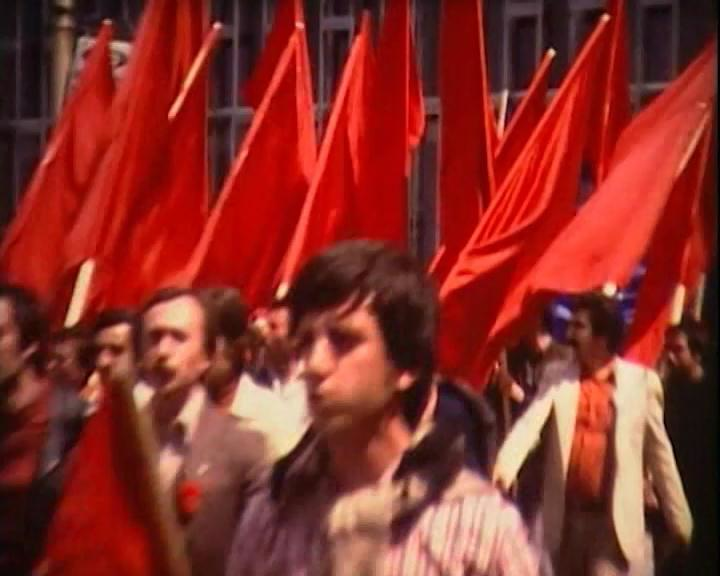
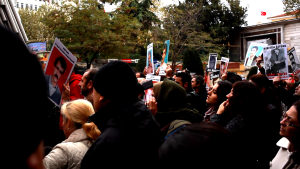
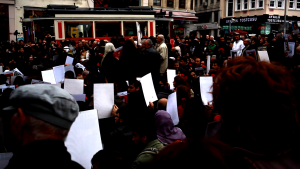
Ever since we first picked up a camera and stepped into the streets, we have repeatedly recorded the words “Present!” and “Here!” following the reading of each name at commemorations for those lost in massacres we have witnessed. Before the commemoration begins, a voice over the megaphone reminds the crowd: “Friends, please make your voices heard as we commemorate those we have lost.” The camera struggles to remain steady among raised fists and victory signs with every collective cry. The camera of the person recording has itself become a clenched fist. The weight of remembrance intensifies. Every utterance of “Present!” transforms into a reckoning that refuses to end with the massacres themselves. Hands that refuse to mourn in the prescribed way, that refuse to make peace with death… Blank, tear-filled eyes gaze into the distance; no one looks at one another. It is as though, with every name that is spoken, we meet the gaze of those we have lost. As the names are repeated and woven into one another, the cries grow louder. The voice that calls each name links the murdered to one another, chaining together the massacres themselves. While every murder has already been archived as evidence, the echo of “Present!” becomes a vow never to mourn a crime that continues to be concealed in plain sight. Every cry of “Here!” multiplies our smallness into a collective presence. Eventually, in these recordings of remembrance, the names come to an end. With the words, “Their memory lives on in our struggle,” fists slowly unclench and hands gradually fall. What memory can we recall without first living it? Does reading, watching, or listening to the moment of a killing also carry within it the helplessness of never being able to reach that moment itself? Life becomes a metaphor. Yet only the metaphor of life can erase death. To struggle in order to remember; to resist through remembrance… Without turning memory into either a mystery or a form of property, there remains the cry: “We witnessed the murder.” In the video recordings, dozens of people echo through the soundtrack. Within the montage taking shape in our minds, in every act of remembrance and every collective cry, every life is, at least as much as we are, present and here.
“…I am one who has died, and yet I am still alive. I am not trying to deceive anyone. When we arrive at the decisive moment, you will see. But I have to begin somewhere, and so I begin with this period—the moment just before the end, which is also the beginning of everything, and the finest of all times if you wish to tell a story.”
Video-Yerleştirme / Installation: Sibel Tekin, Onur Metin, Oktay İnce, Alper Şen – 2016
Videolar 2001-2024, Alıntı: Julio Cortazar – Cinayeti Gördüm / Blow-Up