(Scroll Down For English)
Oranien Platz’dan Oplatz.net’e Dayanışmanın Güncesi
Almanya’da göçmen mücadele hareketlerinde yer alan Turgay’la, hareketin eylem, direniş ve işgallerle elde ettiği kazanımlardan ve son göçmen dalgasının etkilerinden konuştuk.
Artıkişler Kolektifi: Almanya’daki aktif göçmen örgütlerini nasıl tarif edersin?
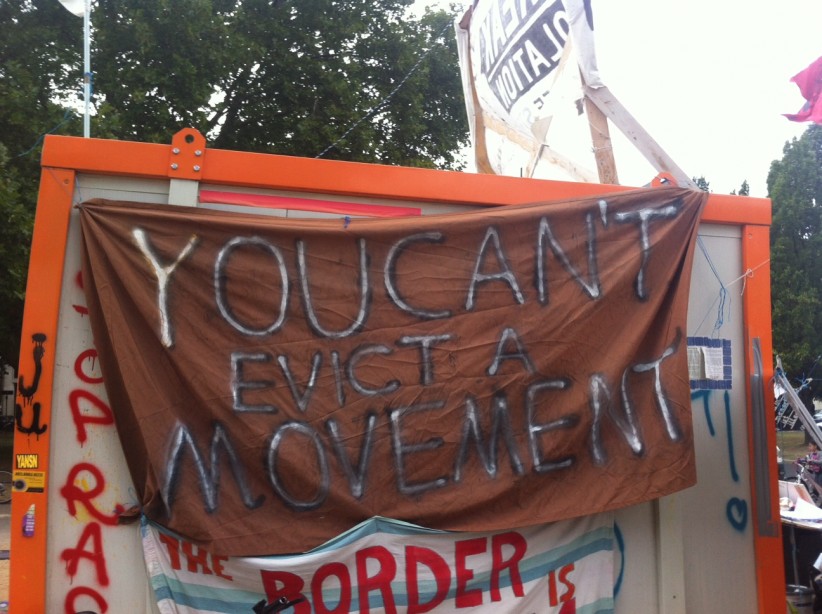
Turgay: Bildiğimiz örgüt tarzı değil, Devrimci Mülteci Hareketi örneğin mültecilerin örgütlediği fiili bir sokak hareketidir. Refugee Movement ve Oranienplatz olarak biliniyor. Avrupa’da mekanın adıyla anılıyor hareket. O nedenle mekan önemli, mekanı kaybettiğin zaman siyasi etkisini yitiriyor. Oranienplatz işgalinde çadırlar önemliydi çünkü göçmenlere uygulanan izolasyonu kıran sembolik bir özelliği vardı. Polis saldırıp Oranienplatz’ı yıkınca ağaç işgal ettik, kadın arkadaş 5 gün kaldı ağaçta. İlk 2-3 gün su ekmek gibi ihtiyaçlarını vermedi polis. Bunun üzerine hemen karşı parkta 22 gün açlık grevi yaptık talepler belirleyip. Hukuken orada politik faaliyetlerimize devam edebilmemiz için iki çadır kurma hakkı verildi. Ama kurduğumuz çadır bir gece ateşe verildi.
Nasıl başlamıştı işgal?
Göçmenlere uygulanan ulaşım yasağı, yemek paketi, çalışma yasağı… Biz dedik ki bu yasakları tanımıyoruz. Eve Almanca’da ‘heim’ diyorlar ama biz, bunları izolasyon kampları olarak tanımlıyoruz. Hapishane gibi değil ama Avrupa’da öyle bir sistem kurmuşlar ki çok inceltilmiş yöntemlerle izole ediyorlar seni. Dışarı çıkman yasak değil ama ayda 40 euro para veriyorlardı biz kaldığımızda 2010, 2011’de. 15 euroluk da kuponlar var, onu veriyorlar. Sen nasıl çıkacaksın ki onunla, diyelim ki bir şehre gitmek istedin. Yasak ama gitmek istesen bile gidemezsin o parayla. Hem bu izolasyonu kırmak için hem de sokakta komünal bir hayat mümkün olabilir diye 1,5 sene değişik kültürlerden insanlarla bir arada yaşayabildik. Kış da geçirdik o çadırlarda. Devamlı orada kalmasak da, meydanı direnişin merkezi olarak kullandık. Ama orayla da kalmadık, sendikaları, partileri, konsoloslukları işgal ettik sınırdışı kararlarına karşı. 2012’den 2015’e kadar sürekli eylemlilikler devam etti. Önce lokalden başlayıp başkente taşıdık direnişi. Almanya çapına yaydık siyasal etkiyi. Sonra da merkezden durup yerellere otobüs turu düzenledik. Almanya’daki 18 mülteci kampına buradan otobüslerle gittik, her yerde eylemler yaparak. Mülteci kampının içinde, dışında, sokak işgalleri ve benzeri… Öyle yaydık yani. Sonra da bütün Avrupa çapına yaydık. Avrupa Birliği ülkelerinde mültecilerle ilgili yasalar aynı nüanslara sahip, mültecileri izole etmek, toplumdan dışlamak ve bunların gönüllü olarak geri dönmesini sağlamak ya da zorla sınır dışı etmek. O nedenle bu sınırlara karşı, frontex’e karşı Strasbourg’dan Brüksel’e yürüdük. Ondan önce bir delegasyon grubu oluşturduk ve Fransa’ya, Hollanda’ya, İtalya’ya gittik. Hem oralardaki mülteci gruplarıyla hem de anti-kapitalist hareketlerle görüşmeler yaptık. Sonra da bu gruplarla Strasbourg’da buluşup Brüksel’e yürüyüş yaptık.
Talepleriniz nelerdi?
Üç ana talep belirledik. Mültecilerin dolaşım yasağı ve mülteci kampları kaldırılsın, sınırdışılar durdurulsun. Dolaşım yasağı önce 30 kilometreyle sınırlıydı sonra eyalet dışına çıkma yasağı konmuştu. Mücadelenin sonunda dolaşım yasağı kaldırıldı mesela. Yemek paketi de kaldırıldı, aylık ücret vermeye başladılar.
Şu anda halen uygulanıyor mu?
Şimdi hepsi daha sert biçimiyle geri geldi. Şimdi daha kötü, sınırdışı uygulamaları var. Bazı ülkeler güvenli ülke ilan edildi; Balkan ülkeleri, Tunus, Cezayir, Fas, Afganistan, Türkiye, buralardan gelenleri hemen gönderiyorlar, diğerlerini de aşama aşama gönderiyorlar. Sonra o yemek paketi geri geldi. Her yerde mülteci kampları açıldı ve durumları insan hakları açısından bizim dönemimizden çok daha kötü. Şu an biz yeni gelen mültecileri örgütlemeye çalışıyoruz. 2013-14’teki dinamizmin şu anda olduğunu söyleyemeyiz. Fakat koşullar ne kadar kötü olursa olsun birileri örgütlemezse olmuyor. Kendiliğinden bir direniş olmuyor, birilerinin başlatması lazım. O yüzden biz direniş deneyimini yeni gelenlere dergiler, broşürler, filmlerle aktarmak istiyoruz, hem de yeni gelenlerle hazırlık toplantıları yapıyoruz. Çeşitli eylemler oluyor ama henüz öyle büyük bir direniş yok.
İltica süreci nasıl işliyor?
Dublin Anlaşması’na göre ilk parmak izin hangi ülkede alınmışsa oraya iade etme hakkı var. Herhangi bir AB ülkesinde parmak izin alınmamışsa burada iltica hakkına başvurabiliyorsun. Sonra seni bir mülteci kampına yerleştiriyorlar, ifadeni alıyorlar sonra bekliyorsun. Eskiden çok uzun zaman alabiliyordu, 3 yıl, 5 yıl hatta 20 yıl kampta kalan insanlarla karşılaştık biz burada. Hiçbir cevap alamamış. Biz mesela 18 yaşında bir çocukla tanıştık burada, mülteci kampında doğuyor ve hala orada yaşıyor iltica sürecinde… Sınır dışı edebilmek için yeni yasaları bu süreci daha hızlı sonuçlandırma biçiminde formüle ettiler. Almanya’nın genç nüfusa ihtiyacı var, bu hiç bitmiyor, o nedenle seçiyor. Kalifiye olanları seçiyor, çalışmaya istekli olanlara daha toleranslı. Çalışmaya hevesli olmayanları ya da kalifiye olmayanları direkt sınır dışı ediyor ya geldiği ya da parmak izinin alındığı ülkeye ya da Türkiye’ye. Toplu halde sınır dışı ediyorlar. Hemen hemen her ay toplu sınır dışılar oluyor.
Eski göçmenlerin dışlayıcı tavrından bahsetmiştin.
Eskiden gelip buraya yerleşmiş, işyeri açmış olanların çoğu yeni gelenleri istemiyor. ‘Bunlar geliyor, iş piyasasını düşürüyor, işte ne bileyim pisler…’ gibi şeyler konuşuluyor. Biz Oranienplatz’tayken burada sorunlar oldu özellikle Türkiye kökenlilerle. Bir kişi bıçaklandı mesela. Görüşmeler yaptık sonrasında, ‘nedir derdiniz’ diye sorduk? ‘İşte bunlar elleriyle yemek yiyorlar, zenciler geldi yerimizi işgal ediyorlar’ deniyordu. Ben de ‘eskiden bunu Naziler size karşı söylüyordu’ dedim. Eskiden barbar bunlar diyorlardı. Kadın resmi koyuyorlardı, işte bana dokunma falan. Şimdi de eski bakış açısı devam ediyor. Almanya’da ırkçılık bunun üzerinden yayılıyor, ‘bunlar çalışmıyor, devletten bedava geçiniyor, nasıl yaşanacağını bilmiyor’. Almanya’nın bazı eyaletlerinde mültecilere davranış kurallarıyla ilgili broşürler çıkardılar, eğitim falan yapıyorlar.
Eski göçmenlerle görüşmelerimizde ‘biz de sizden rahatsız oluyoruz dedik; güzel yemekler yiyorsunuz, güzel apartmanlarda oturuyorsunuz, duş yapıyorsunuz, kaşıkla yemek yiyorsunuz’. Şok oldular önce, sonra durumlarını anlattık; bu insanlar Libya’dan geliyor, orası bombalandı, insanlar ailesini, işini kaybetti. Bir süre sonra anlamaya başladılar keyfinden gelmediğini kimsenin. Bir kısmı sonra destek oldu, çay, yemek getirdi. Bunu diyalogla çözdük yani.
Türkiye’de de benzer bir durum var. Peki şu an göçmen nüfusu nedir Almanya’da?
Almanya’da şu anda 1 milyon olduğu söyleniyor göçmen sayısının. Türkiye’de göçmenlere karşı geliştirilen argümanlarla buradakiler çok farklı değil, ‘işimizi elimizden alıyor, piyasayı düşürüyor, devlet bunlara para veriyor, vergimizden yiyorlar’ gibi ama realite öyle değil. Almanya’da çalıştırılıyorlar mesela, kaldığın mülteci kampında saati 1 euroluk işler var, bulaşık, bahçe temizliği vs. Normalde saati 8,5 euro burada. Bir ekonomik yükten falan söz edilemez aslında Almanya açısından.
Kürt göçmenlere karşı tutum nedir?
Yeni yeni Kürt göçmenler gelmeye başladı. Mesela Ezidi Kürtlere daha açık, inanç baskısı gördüğü için daha hızlı transfer edebiliyor. Suriye’den gelenlere 1 yıla kadar toleranslı. Balkan ve Afganistan’dan gelenler öyle değil. Yaptığımız eylemlere Afganistanlı daha çok insan katılıyor, Suriyeliler daha az katılıyor mesela. Kavgalar da çıkıyor aralarında. Kürtlere saldırılar oluyor, Çeçen mülteciler Ezidi Kürtlere saldırdı en son mesela.
Siz nasıl örgütlendiniz bu parçalanmış gruplar arasında?
Daha önce politik mücadeleler içinde yer almış mülteciler vardı, biz birbirimizle konuşabildik. Kamptaki bir intihar olayı bizi etkiledi, orada kalan insanlar bu böyle olmaz dedik kendi aramızda, insanlar izolasyonla ölüyor. Erfuhrt’ta bir kamp yaptık ve Berlin’e yürüyüş fikri oradan çıktı. Parlamento burada, Berlin Almanya’nın merkezi. Ben Osnabrück’teydim, şehre 30 km uzak, Hollanda askerlerinin II. Dünya Savaşı’nda kullandığı bir askeri kamp. Bir insanla ya da medyayla diyalog kurma şansın yok. Yani oradaki sorunu anlatma şansın yok. Biz yine de orada çeşitli eylemler yapıyorduk ama lokal kalıyordu. O yüzden başkente yürüme fikrini geliştirdik. Bu eylem sorunun yeniden tartışılmasını sağladı, parlamento tartıştı, belediyeler tartıştı, sosyal hareketler tartıştı. İster istemez bir dinamizm oluştu.
Oplatz işgali nasıl sonlandı?
Oplatz, polis saldırıları ve ırkçı saldırılarla kırılamayınca içeriden bölme taktiğini uyguladılar, o etkili oldu mesela. Senatodan göçmenlere normal hayat vaadinde bulundular. İnsanlar o kadar zor şartlardan geçmişlerdi ki, kabul ettiler. Biz de mesela Türkiye’den bir milletvekiliyle görüştük. Berlin’de kalma hakkı ve oturum hakkı vereceğiz diye söz verdiler. İmzalı kağıt istedik, parlamentoya güvenmiyoruz dedik. Kağıdı vermediler, biz de bu kirli bir oyundur, meydanı terk etmiyoruz dedik ve parlamentoyu terk ettik. Diğerleri kabul etti bu sözü, 100’lerce kişi… Bunları önce apartmanlara yerleştirdiler şehirde ama uzun sürmedi, 3 ay sonra polis zoruyla hepsi boşaltıldı. Bunu kabul eden mültecilerden birisi mesela, Oranienplatz’ta kendine benzin döküp yakma girişiminde bulundu ama söndürdüler tabii… O zaman bizim haklı olduğumuzu gördüler anlaşmayı kabul edenler. İçeriden birileriyle işbirliği yapma metodu sömürgeci bir taktik. Bütün sömürgelerde böyle yapıyorlar. Bu sömürgelerde uyguladıkları taktiklerin aynısını uyguladılar burada Oplatz’ta da. Mesela bizim aleyhimize açıklamalar yaptırtıyorlardı göçmenlere.
Okul işgali nasıl gerçekleşti? Halen kalanlar var değil mi?
Çocuklar, kadınlar vardı, kışın kalmaları zor oluyordu meydanda. Okulu işgal ettik. 9 gün boyunca direndik ve işgali kazandık. O zaman belediye başkanı Mart sonuna kadar kalsınlar dedi ama o uzadı hep, çünkü sorun çözülmedi. Halen de devam ediyor. Polis boşaltmaya çalıştı, o zaman ilk çatı işgali gerçekleşti. Almanya’da yeni eylem formları oluştu göçmen hareketiyle, çatı işgali ve ağaç işgali gibi. Çatışmalar sırasında bir grup Romen terk etti binayı, şimdi sokakta yaşıyor onların bir kısmı. 300 kişi kalıyordu okulda, evsiz Almanlar vardı. Ortak yemekhane kurmuştuk, müzik yapıyorduk, dil kursları vardı. Mahkeme bizim lehimize karar verdi tabii belediye kağıt imzaladığı için.
Antoni Negri’nin dediği gibi kapitalizmin yeni hayaleti göçmenler mi, işçiler daha eski bir tehdit olarak mı kaldı?
Biz de işçiyiz aslında, göçmenler de potansiyel işçiler. Biz burada sendikalardan üye olma hakkı talep ettik. Çalışma hakkımız olmadığı için sendikaya üye olabiliyorsun ama bu hiçbir işe yaramıyor. Biz direnişe başlarken ‘refugee strike’ dedik yani mülteci grevi. Bu aynı zamanda bir sınıf meselesidir diyorduk. Çünkü herkes geldiği kolonyal yerlerin baskı ve sömürüsünden kaçıyor, buraya geldiklerinde de ırkçılıkla, kapitalizmle eziliyor, sömürülüyorlar. Biz de potansiyel işçi sınıfının içindeyiz ve sizinle sorunumuz aynı ve aynı yerde mücadele etmemiz gerek dedik. Sendika şubesini işgal ettik. Bruno dedi ya ‘hoşgeldin kültürü’nde problem var diye, bize ‘willkommen, hoşgeldiniz’ yazdılar önce. Biz binanın içinde kaldık tabii ve dedik ki bizi taleplerimizle ilgili yetkili biriyle görüştürün. Kabul etmediler ve sonra şöyle yazdılar, ‘Mülteciler hoşgeldi ama bizim evimizi işgal etmeye hayır’. ‘Burası bir sendika, eviniz değil, işçi sınıfını temsil etmeniz lazım, ne demek bizim evimiz. Bizim sorunlarımızla ilgilenmeniz lazım, biz de çalışma hakkı istiyoruz, sendikaya üye olmak istiyoruz’ dedik. O süreç boyunca mülteciler işçi sınıfı mıdır değil midir gibi tartışmalar yaptık ve sendikanın tabanındaki gruplarla da eylemler yaptık, hala da devam ediyoruz.
Oplatz hareketinin sitesi: http://oplatz.net/
Daily Resistance göçmen gazetesi: http://dailyresistance.oplatz.net/
Wearebornfree göçmen radyosu: http://wer.oplatz.net/
- Bu metin göçmen dayanışma ağları üzerine 2016 ylında gerçekleştirilen “Geride Kalanlar” görsel araştırmasından alınmıştır.
Özge Çelikaslan – Alper Şen
Artıkisler Kolektifi – Berlin 2016
The Diary Of Solidarity from Oranien Platz to Oplatz.net
We spoke with Turgay, who has been involved in migrant struggles in Germany, about the gains achieved through actions, resistance, and occupations, and about the effects of the latest wave of migration.
How would you describe the active migrant organizations in Germany?
Turgay: They are not organizations in the conventional sense. The Revolutionary Refugee Movement, for example, is essentially a street movement organized by refugees themselves. It is known as the Refugee Movement and as Oranienplatz. In Europe, the movement is often identified by the name of the place where it emerged. That is why the place itself is important. Once you lose the space, you lose part of your political impact. During the Oranienplatz occupation, the tents were important because they had a symbolic function: they broke the isolation imposed on migrants. When the police attacked and dismantled Oranienplatz, we occupied a tree. A woman activist stayed in the tree for five days. During the first two or three days, the police did not even provide basic necessities such as water and bread. In response, we immediately began a hunger strike in the park across the street. It lasted twenty-two days. We formulated demands and negotiated around them. Eventually, we were legally granted the right to erect two tents so that we could continue our political activities there. But one night, one of the tents we had erected was set on fire.
How did the occupation begin?
The restrictions imposed on migrants were the starting point: restrictions on movement, food packages, and the right to work. We said: We do not recognize these prohibitions. In German, the places where refugees are accommodated are called Heim. But we defined them as isolation camps. They are not prisons in the conventional sense. Yet Europe has created a system in which people are isolated through highly refined and indirect mechanisms. You are not necessarily forbidden from leaving. But when we were there, in 2010 and 2011, we were given only €40 a month. We were also given €15 worth of vouchers. How are you supposed to go anywhere with that? Let’s say you want to travel to another city. You may not be explicitly prohibited from doing so, but even if you want to go, you cannot afford the journey. We wanted to break this isolation and demonstrate that a communal life in the streets was possible. For a year and a half, people from different cultural backgrounds lived together there. We spent winters in those tents. Even when we were not physically staying there all the time, we used the square as the center of the resistance. But we did not stop there. We occupied trade unions, political party offices, and consulates in protest against deportation decisions. From 2012 to 2015, there was continuous political activity. We started locally and then moved the resistance to the capital. We expanded its political impact across Germany. Then we stayed in Berlin and organized a bus tour to local communities. We travelled by bus to eighteen refugee camps across Germany. At every stop, we organized actions. Inside the refugee camps, outside them, occupations of streets and other forms of protest—we spread the movement in this way. Eventually, we extended it across Europe. The laws concerning refugees in European Union countries differ in their details, but they share a common logic: isolating refugees, excluding them from society, encouraging them to return voluntarily, or forcibly deporting them. So, in opposition to these borders and to Frontex, we marched from Strasbourg to Brussels. Before that, we formed a delegation and travelled to France, the Netherlands, and Italy. We met with refugee groups and anti-capitalist movements there. Then we brought these groups together in Strasbourg and marched to Brussels.
What were your demands?
We formulated three main demands: The restrictions on refugees’ freedom of movement must be abolished. Refugee camps must be abolished. Deportations must stop. At first, the restriction on movement applied to a radius of thirty kilometers. Later, refugees were prohibited from leaving their federal state. At the end of the struggle, the restriction on movement was abolished, for example. The food packages were also abolished, and they began providing a monthly allowance instead.
Are these restrictions still in place?
Now they have all returned in much harsher forms. Deportations are more severe now. Some countries have been declared “safe countries”—the Balkan countries, Tunisia, Algeria, Morocco, Afghanistan, Turkey. People arriving from these countries are deported immediately, while others are deported gradually. The food-package system has also returned. Refugee camps have been established everywhere, and in terms of human rights, the conditions are much worse than they were during our period. We are now trying to organize the newly arrived refugees. We cannot say that the same dynamism that existed in 2013–14 exists today. But no matter how bad the conditions are, nothing happens unless someone organizes. Resistance does not emerge spontaneously. Someone has to start it. That is why we want to transmit our experience of resistance to newly arrived refugees through magazines, pamphlets, and films. We are also holding preparatory meetings with newly arrived migrants. There are various actions taking place, but there is not yet a major resistance movement on the scale we had before.
How does the asylum process work?
Under the Dublin Regulation, if your fingerprints have been registered in another European country, Germany has the right to return you to that country. If your fingerprints have not been registered in another EU country, you can apply for asylum here. Then they place you in a refugee camp, take your statement, and you wait. In the past, this could take a very long time. We encountered people who had spent three, five, even twenty years in camps without receiving any answer. For example, we met an eighteen-year-old here who had been born in a refugee camp and was still living there, waiting for his asylum process to be completed. They have now formulated new laws designed to accelerate this process, particularly in order to facilitate deportations. Germany needs a young workforce. That demand never disappears. So they select. They select people who are qualified and are more tolerant toward those who are willing to work. Those who are considered unwilling to work or insufficiently qualified are deported directly—to the country they came from, the country where their fingerprints were registered, or to Turkey. They carry out mass deportations. There are almost monthly collective deportations.
You mentioned the exclusionary attitude of older migrant communities.
Many people who came here years ago, settled, and opened businesses do not want the newly arrived migrants. You hear things like:“They are coming and driving down wages.”“They are dirty.”And so on. When we were at Oranienplatz, there were particular tensions with people of Turkish origin.There was an incident in which someone was stabbed.Afterwards, we held meetings and asked:“What exactly is your problem?” They said things like: “They eat with their hands.” “Black people have come and occupied our place.” I told them: “The Nazis used to say the same things about you.” They used to call you barbarians. They used to put up images of women with captions saying, “Don’t touch me,” and so on. That old mentality is still continuing. This is one of the ways racism spreads in Germany: “They don’t work.” “They live off the state for free.” “They don’t know how to live properly.” In some German states, they have even produced brochures about rules for how refugees are expected to behave and organized educational programs around them. When we met with older migrant communities, we told them: “We are also disturbed by you. You eat good food. You live in nice apartments. You take showers. You eat with spoons.” They were shocked at first. Then we explained their situation. These people were coming from Libya. Their country had been bombed. They had lost their families and their jobs. After a while, they began to understand that nobody had come here simply because they wanted to. Some of them later began supporting us. They brought tea and food. We resolved this through dialogue.
There is a similar situation in Turkey. What is the migrant population in Germany at the moment?
It is said that there are currently around one million migrants in Germany. The arguments used against migrants in Germany are not very different from those used in Turkey: “They are taking our jobs.” “They are driving down the market.” “The state gives them money.” “They live off our taxes.” But the reality is different. In Germany, for example, migrants are employed under extremely low-paid conditions. In the refugee camps, there are jobs that pay one euro an hour—washing dishes, cleaning gardens, and so on. The normal minimum wage here is €8.50 an hour. So, from Germany’s perspective, it is actually difficult to claim that migrants constitute some kind of economic burden.
What is the attitude toward Kurdish migrants?
Kurdish migrants have only recently begun arriving in larger numbers. For example, there is greater openness toward Yazidi Kurds because they have experienced religious persecution, and their applications can therefore be processed more quickly. There is a tolerance of up to one year toward people arriving from Syria. It is different for people arriving from the Balkans or Afghanistan. More Afghans, for example, participate in the actions we organize, while fewer Syrians participate. There are conflicts between different groups as well. There have been attacks against Kurds. Most recently, Chechen refugees attacked Yazidi Kurds, for example.
How did you organize across these fragmented groups?
There were refugees among us who had previously been involved in political struggles. That meant we could communicate with one another. An incident involving a suicide in one of the camps affected us deeply. Those of us living there said among ourselves: “This cannot continue. People are dying because of isolation.” We organized a camp in Erfurt, and the idea of marching to Berlin emerged from there. The parliament is here. Berlin is the political center of Germany. I was living in Osnabrück, thirty kilometers outside the city, in a former military camp used by Dutch soldiers during the Second World War. You had almost no opportunity to speak to anyone or communicate with the media. There was no way to make the problem visible. We were organizing various actions there, but they remained local. That is why we developed the idea of marching to the capital. The action forced the issue back into public debate. Parliament discussed it. Municipal governments discussed it. Social movements discussed it. Inevitably, a new political dynamism emerged.
How did the Oranienplatz occupation end?
When the occupation could not be broken through police attacks or racist attacks, they adopted a strategy of division from within. That proved effective. The Senate promised the migrants a return to a “normal life.” People had been living under such difficult conditions that many accepted the promise. We also met with a member of parliament from Turkey. They promised that we would be given the right to remain in Berlin and obtain residence permits. We asked for a signed document. We said: “We don’t trust parliament.” They refused to give us the document. So we said: “This is a dirty trick. We are not leaving the square.” And we left the parliament building. Others accepted the promise—hundreds of people. At first, they were placed in apartments across the city. But it did not last long. Three months later, all of them were evicted by the police. One of the refugees who had accepted the agreement later attempted to set himself on fire by pouring gasoline over himself at Oranienplatz. Fortunately, they were able to put out the fire. That was when those who had accepted the agreement realized that we had been right. The strategy of collaborating with selected individuals from within a movement is a colonial tactic. They use the same tactic in all colonial situations. They applied exactly the same method here at Oranienplatz. For example, they would get migrants to make public statements against us.
How did the school occupation happen? Are there still people living there?
There were children and women there, and it was difficult for them to stay in the square during the winter. So we occupied the school. We resisted for nine days and won the occupation. At the time, the mayor said they could stay until the end of March. But that deadline kept being extended because the problem had not been resolved. It is still continuing today. The police attempted to evict the building. That was when the first rooftop occupation took place. The migrant movement generated new forms of protest in Germany, such as rooftop occupations and tree occupations. During the confrontations, a group of Romani people left the building. Some of them are now living on the streets. Around three hundred people were living in the school. There were also homeless Germans. We established a communal kitchen. We made music. There were language courses. The court eventually ruled in our favor because the municipality had signed an agreement allowing the occupation to continue.
As Antonio Negri suggested, migrants are the new specter of capitalism, while workers remain an older threat.
We are workers too, actually. Migrants are potential workers. We demanded the right to join trade unions here. Because we did not have the right to work, we could technically join a union, but it was useless. When we began our resistance, we called it a “refugee strike.” We were saying that this was also a question of class. Everyone is fleeing oppression and exploitation in the colonial places they come from. When they arrive here, they are subjected to racism and capitalism. They are oppressed and exploited again. We are part of the potential working class. Our problem is the same as yours. We have to struggle in the same place, together. We occupied a trade union branch. Bruno said there was a problem with the so-called “welcome culture.” At first, they put up signs saying: “Willkommen. Welcome.” Of course, we stayed inside the building. vWe said: “Put us in contact with someone who has the authority to address our demands.” They refused. Then they changed the message: “Refugees are welcome, but not in our home.” We said: “This is a trade union, not your home. You are supposed to represent the working class. What do you mean, ‘our home’? You should be dealing with our problems. We want the right to work. We want the right to join the trade union.” Throughout this process, we debated whether refugees are part of the working class. We also organized actions together with groups at the grassroots level of the trade union. And we are still continuing that struggle.
Online Resources
Oplatz – Refugee Movement: http://oplatz.net/
Daily Resistance – Migrant Newspaper: http://dailyresistance.oplatz.net/
We Are Born Free – Migrant Radio: http://wer.oplatz.net/
- This text is drawn from the visual research project “The Residuals”, conducted in 2016, which focused on migrant solidarity networks.
Özge Çelikaslan – Alper Şen
Artıkisler Collective –Berlin 2016