(Scroll Down For English)
Birlikte Yaşıyoruz, Dayanışmamız Kazanacak
Atina Göçmen Dayanışma Hareketi’nden Olga ile konuştuk: “İşgal etmek bir amaç değildir, ihtiyacı olan insanların barınması için bir araçtır”
1990’lı yıllar, Yunanistan’a kitlesel göçün başladığı yıllar oldu. Çünkü daha önce, Yunan vatandaşları Kuzey Avrupa’ya ve Amerika’ya göç etmekteydiler. Bu nedenle Yunanistan’da göçten bahsettiğinizde önce Yunanlılar kendi göçlerinden bahsedildiğini sanıyorlar. Göç kavramının Yunanistan’daki halklar için çok derin, tarihsel bir belleği var. Ancak 1990’larda Sovyetler Birliği’nin yıkılması ve Balkan coğrafyasındaki değişimin sonunda göçmenlerin de Yunanistan’a gelebildiğine tanık olduk. Özellikle 90’lardan itibaren Arnavutluk’tan Yunanistan’a kitlesel bir göç başlamıştı. Bu dönemde çok sert bir ırkçılık ortaya çıktı Yunanistan’da. O zamanlarda birçok reformist gazetenin bile Arnavutlar hakkında çok rahatsız edici başlıklar attığını hatırlıyorum. 1990’larda “Arnavut olmak” hakaret gibi algılanmaya başlamıştı. Bu dönemde bazı yoldaşlarla birlikte göçmenlerle ve mültecilerle dayanışmak için bir grup oluşturmuş ve Excharhia’da bir sosyal merkez açmıştık ki bu merkez hala çalışmalarını sürdürüyor. Bu merkezde ücretsiz Yunanca ve diğer dil kurslarından, yasal destek masaları oluşturmaya kadar faaliyetler organize ederken, bir yandan da göçmenlerin sorunlarını politik düzlemde tartışıyorduk. Bir yandan da göçmenlerin kendi organizasyonlarını, kendi kolektiflerini oluşturması için çalışmalar yürütüyorduk. Bu nedenle sloganımız, “Varlığımız ancak bize artık ihtiyaç duyulmadığında anlamlı olur”du. Göçmenler ve mülteciler toplumdaki herkesle eşit haklara sahip olmalıydılar ve bizim onlar adına konuşmamızdansa onların kendi hakları için de mücadele edebilecek bir kolektif yapıya sahip olmaları gerekiyordu. Bu nedenle Yunanistan’da göçmenlerle yürütmekte olduğumuz mücadelenin böyle bir geçmişi var. Bu yaz Atina Irkçılık Karşıtı Festivali’nin 19. yılını düzenleyeceğiz. Her yıl 30-40 bin katılımcı bu festivale geliyor.
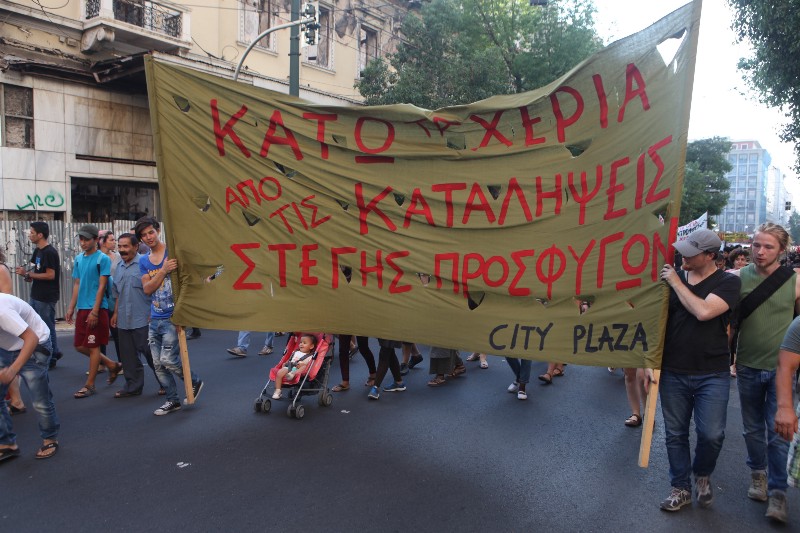
City Plaza Oteli dört farklı kolektif tarafından yürütülüyor. Bu işgal otelinin dışında bu amaç doğrultusunda ilk işgal evi Atina Excharhia’da 2015 Ekim ayında kuruldu. O günlerde de Victoria Meydanı’ndaki bu oteli hep görüyorduk ve otel hakkında bazı fikirler geliştiriyorduk. Sınırlar açıktı, insanlar burada sadece birkaç günlüğüne kalıyorlardı ve sonra yollarına devam ediyorlardı. Bu nedenle yerleşim burada çok da öncelikli bir sorun değildi. Bu yüzden önceliğimiz daha çok yemek temini ya da tıbbi destek oluyordu ilk dönemlerde. Göçmenlerin yolculuk rotasını takip ederek dayanışmayı sürdürmeye çalışıyorduk.
Ancak, Avrupa Birliği’nin Türkiye ile anlaşması sonrasında sınırlar kapanınca, buradaki insanlar için kalıcı mekanlar oluşturmanın acil bir ihtiyaç olduğunu düşünmeye başladık. Bu aynı zamanda farklı bir politik söyleme de denk düşüyordu. Halen sınırların açılması ve herkes için dolaşım özgürlüğü için mücadele vermeye devam ediyoruz. Bununla birlikte, buradaki halkla da “artık burası bir geçiş alanı değil, insanlar burada bizimle yaşayacaklar” gerçeğini tartışmaya başladık. “Hoşgeldiniz” demek, sadece göçmenlere yemek vermekten ibaret değildir. “Hoşgeldiniz”, gelenlerin de sizinle birlikte bir yaşam alanına sahip olduklarını kabul etmek anlamına gelmelidir. Bunu kabul etmek de insanlar için kolay olmuyor. Herkes şunu söylüyor: “Zavallı göçmenler, çok zor durumdalar, onlara yiyecek vs vermek gerekiyor”. Bunu önemsiz görmüyorum, aksine bu farkındalık da çok önemli. Ancak insanlar halen mevcut toplum yapısının biraz değişeceği / değişmesi gerektiği gerçeğine mesafeli bakıyorlar. 50 bin göçmen, Yunanistan nüfusu ile karşılaştırdığımızda çok düşük bir oran. Anaakım medyada tarif edildiği gibi bu göçmen nüfusunun toplumsal yapıda dramatik bir dönüşüme neden olması pek mümkün değil.
Bu “kabullenme” de aslında bir süreçtir, bugünden yarına değişecek bir şey değil… Bu oteli örnek alalım, burada 400 kişi kalıyor. Küçük bir köy nüfusu kadar… Böyle bir köyün de kendi dili, kendi alışkanlıkları ve geldikleri, büyüdükleri toplumun yapısı sonucu bir ortak alışkanlıkları olması ve kendi toplumsal yapılarını sürdürmeleri gerekir. Burada, bizimle birlikte yaklaşık 450 kişi yaşıyor. Birçok kişinin çok farklı toplumsal geçmişi var ve farklı hayat tarzlarını bırakıp gelmişler. Buraya ilk defa gelen her aileye ya da kişiye burasının nasıl yürütüldüğünü anlatıyoruz. Burada bir ücret ya da beklenti karşılığında insanların çalışmadığını, devletten ya da bir sivil toplum örgütünden destek almadığımızı, her şeyin dayanışma ile gerçekleştirildiğini ve kişilere özel bir uygulama yapılmadığını anlattık. Yani birlikte temizliyoruz, birlikte pişiriyoruz, birlikte yiyoruz, kolektif yaşamaya çalışıyoruz. Aynı politik düşünceden olmayan insanlara da bunu elimizden geldiğince anlatmaya çalışıyoruz. Bunu Somali’den gelen kadına anlattığımızda, birden heyecanlandı: “Yani askeri kamplar gibi değil mi?” Bu cevaba biraz moralimiz bozulsa da yeniden her şeyi anlatmaya çalıştık. Burada yaşayan bazı insanlar bizim “iyi insanlar” olduğumuzu düşünüyor, bazıları bu süreçten kesin bir kazancımız olduğunu düşünüyor. Burada kaç kişi, bizim tam olarak nasıl bir politik ve sosyal amaçla burada olduğumuzu, savunduğumuz hakları, müşterek yaşama dair düşüncelerimizi biliyor emin değilim. Geçenlerde iki göçmen arasındaki tartışmada biri, “buranın müdürü ile görüşmek istiyorum” dedi. Ona, uzun süre burada müdür olmadığını, burada bir hiyerarşinin olmadığını anlattık. Buraya gelen birçok insan hiyerarşinin kurumsallaştığı toplumsal yapılardan geliyorlar. Konuşma yapmak yerine toplantılar, forumlar düzenlemek, rizomatik ilişkiler oluşturmak çok garip gelebiliyor. Yani bir beceriye ve yeteneğe sahip olunca bunu bireysel bir ayrıcalık ve güç gibi kullanmaktansa bunu kolektif bir duyguyla paylaşmak gerektiğini söylemek ve bunun önemine insanları inandırmak pek de kolay bir şey değil. Bizim de bu konuda geniş bir deneyim ve birikimimizin olduğunu söyleyemem. Bu nedenle sürekli her kararı ya da uygulamayı defalarca tartıştığımız da oluyor. Ancak birkaç kişiyle, mesela Kobané’den gelen göçmenlerle benzer bir anlayış içinde olduğumuzu söyleyebilirim.
Kadına yönelik şiddet konusunda da net kurallarımız var. Bir erkek karısına ya da başka bir kadına şiddet uygularsa buradan atılıyor. Kadınsa burada kalabilir ya da erkekle beraber buradan ayrılabilir, bu onun tercihi oluyor. Fakat kadınla bu durumu detaylı biçimde konuşuyoruz.
Burada mücadeleye katılan ve aynı zamanda da bu koşullarda “bekleyen” insanlar var. Bu bekleyiş de özgürlüğe ulaşma sürecinin kendisidir. Yani bir çadırda bekleyerek değil, aynı zamanda hakları için mücadele ederek… Birlikteyken “gücümüz” olduğunu göstermeye çalışıyoruz. Bu nedenle burada göçmenler, City Plaza Oteli’nin yönetimindeler. Otelin teknik sorunlarının çözülmesinden, göçmelerin anadilde eğitim görmesi için öğretmen teminine kadar her aşamada birlikte çalışıyoruz. Yani burada “biz burada sadece kalıyoruz” düşüncesinde değiller. Dayanışmadan insanlar otelin idaresinin her aşamasında göçmenlerle birlikteler. Bununla birlikte örneğin aşırı korumacı olmamaya çalışıyoruz. Bir göçmenin hastaneye gitmesi gerektiğinde onun elinden tutup hastaneye götürmenin bir yöntem olmadığını düşünüyoruz. Yolu ve yordamı tarif ettiğinizde, City Plaza’dan çıkıp bir hastaneye gidebilirler ve tedavi olabilirler. Elbette dil bir sorun iletişim konusunda… Ama artık burada yaşıyorsanız bir şekilde insanlarla iletişimi kendiniz kurmanız gerekecek. Şehri biliyor olmanız, yani kendinizi idare edebilecek olmanız da gerekecek. Çünkü artık bu toplumun bir parçası oluyorsunuz.
Bu işgal evi politik bir projedir. Belki de bir ay sonra burası olmayacak. Bu nedenle burası resmi bir “iltica” merkezi değil. Elbette burası tıbbi yardımdan eğitime kadar birçok konuda bir merkez gibi işliyor olabilir ama bunun ötesinde yasal iltica konusunda danışmaları için başka merkezlere insanları yönlendiriyoruz. Yunanca kursları konusunda insanlar sosyal merkezlere gidiyor. Burada Yunanca kursu vermiyoruz. Bu politik bir karar. Çünkü insanların dışarıya çıkması, sosyalleşmeleri, toplumla nasıl iletişime geçmelerini öğrenmeleri gerekiyor. Örneğin buradaki çocukları Eylül’de başlamaları için Cuma günü ilkokula kayıt olmaya götürdük. Sabah sekiz buçukta resepsiyonda buluşup çocuklar için gerekli belgeleri düzenleyip dokuz buçukta okula gitmeyi planlıyorduk. Oysa sabah sekiz buçukta onlarca çocuk çoktan hazırlanmışlar, çok güzel giyinmişler, okul çantaları ve ellerinde belgelerle bizi resepsiyonda bekliyorlardı. Hepsi “Okula gidiyoruz” diyerek neşe içinde yürüyorlardı. Komik bir durumdu çünkü Haziran ayındaydık ve aslında o gün okulun son günüydü. Ama o gün okula gidişimiz, tüm çocuklar için geleceğe yönelik bir umuttu. Yani belki bir-iki ay sonra buradan ayrılacaksınız, başka bir ülkeye gideceksiniz ama ayrılmazsanız da Eylül’de çocuğunuzu okula götürmeniz gerekecek. City Plaza’da nüfusun neredeyse yarısını Suriyeliler, diğer yarısını da Afganlar oluşturuyor. Afgan çocukların hepsi okula kayıt oldular. Suriye’den ve Irak’tan sadece birer çocuk okula kayıt yaptırdı. Bu aynı zamanda buraya nasıl baktıklarını ve aynı zamanda Avrupa Birliği politikalarının insanların yaşamlarını belirlemede ne kadar etkili olduğunu gösteriyor.
City Plaza Otel, 7 yıldır borçlarından dolayı boştu ve satılamıyordu. Bu nedenle her durumda burayı yasal bir statüye kazandırmamız mümkün değildi. Özel mülkiyeti bir işgal evine dönüştürmemiz bizim için de büyük bir risk. Ama burası boşaltılsa da boşaltılmasa da bu finansal değil, politik bir sorun. Çünkü buradaki 400 kişiye başka bir barınma olanağı sağlayamadan burayı boşaltamazsınız. Dolayısıyla bu belirsiz durumdan da faydalanarak burayı göçmenlerin barınması için kullanıyoruz. Bina, yasal olarak sorunlu olsa da sosyal ve politik anlamda bir avantajımız var. Burası elbette ki göçmenlerle dayanışmamızı göstermemiz açısından önemli bir yer ama aynı zamanda kapitalizm altındaki özel mülkiyetin ne anlam ifade edebildiğini de böylece tartışabiliriz. İşgal etmek bir amaç değildir, ihtiyacı olan insanların barınması için bir araçtır. O nedenle burayı bir işgal evi gibi görmektense burayı “Göçmenler İçin City Plaza Oteli” olarak tanımlıyoruz. Bir yandan da şu soruyu soruyoruz: Kullanımda olmayan özel mülkiyet, barınmaya ihtiyacı olan insanlar için kullanılamaz mı? Yani toplum için hangisi daha önemli, insanların barınma hakkı mı, yoksa kullanılmayan bir binanın mülkiyeti mi? Böyle durumlarda en azından kapitalizmin temel kanunlarına tırnaklarını geçirebiliyorsun ve “neden?” diye sorabiliyorsun… City Plaza Oteli bir çözüm değil, sadece nasıl olabileceğine dair bir örnek… İşgal evleri 50 bin göçmenin yerleşimi için asla kalıcı bir çözüm olamaz. Ancak bu bir örnektir. Dayanışma ile mücadele içinde olacağımızın bir örneğidir.
Burası, Victoria Meydanı, faşistlerin daha çok yaşadığı bir bölge. Burası uzun yıllar göçmenler için çok tehlikeli yerler oldu. Altın Şafak üyeleri yakalanana kadar göçmenler buradaki “güvenlik” elemanlarından korkardı. Buraya gecede 4, 5 saldırı oluyordu. O nedenle City Plaza’nın burada bizim için varlığı daha önemli çünkü şehrin herhangi bir yerinde faşistler tarafından kontrol edilen bir yer istemiyoruz. Bu nedenle City Plaza Oteli, göçmenler için barınma hakkının ötesinde özel mülkiyetin sorgulanmasından, dayanışmayı yaymaya ve faşizmle mücadeleye kadar genişleyen anlamlar içeriyor.
- Bu metin göçmen dayanışma ağları üzerine 2016 ylında gerçekleştirilen “Geride Kalanlar” görsel araştırmasından alınmıştır.
Özge Çelikaslan – Alper Şen
Artıkisler Kolektifi –Atina 2016

We Live Together, Our Solidarity Will Win
We Spoke with Olga from the Athens Migrant Solidarity Movement: “Occupation Is Not an End in Itself; It Is a Means of Providing Shelter for Those Who Need It”
The 1990s marked the beginning of mass migration to Greece. Before that, Greek citizens themselves had been migrating to Northern Europe and the United States. For this reason, when you talk about migration in Greece, Greeks initially tend to assume that you are referring to their own history of migration. The concept of migration carries a deep historical memory among the people of Greece.Yet following the collapse of the Soviet Union and the transformations that took place across the Balkans in the 1990s, we witnessed migrants arriving in Greece as well. From the beginning of the 1990s in particular, mass migration from Albania to Greece began. A particularly harsh form of racism emerged in Greece during this period. I remember that even some reformist newspapers were publishing deeply disturbing headlines about Albanians. During the 1990s, being “Albanian” gradually became something that could itself be perceived as an insult. At that time, together with several comrades, we established a group to organize solidarity with migrants and refugees and opened a social center in Exarchia, which is still active today. At the center, we organized activities ranging from free Greek and other language courses to legal support desks. At the same time, we discussed migrants’ problems on a political level and worked to encourage migrants to establish their own organizations and collectives. Our slogan was therefore: “Our existence will become meaningful only when we are no longer needed.” Migrants and refugees should have equal rights with everyone else in society. Rather than speaking on their behalf, we believed they needed to develop collective structures through which they could also fight for their own rights. This is the historical background of the struggle we have been carrying out together with migrants in Greece. This summer, we will organize the nineteenth edition of the Athens Anti-Racist Festival. Every year, between 30,000 and 40,000 people participate in the festival.
City Plaza Hotel is run collectively by four different groups. Apart from this occupied hotel, the first occupied building established specifically for this purpose was created in Exarchia, Athens, in October 2015. At that time, we could already see this hotel in Victoria Square and had begun developing ideas about it.The borders were still open. People were staying here for only a few days before continuing their journeys. Settlement was therefore not yet the most urgent problem. Our priorities during the initial period were more often the provision of food and medical assistance. We tried to maintain solidarity by following the routes along which migrants were travelling.
But once the borders were closed following the agreement between the European Union and Turkey, we began to realize that creating permanent spaces for the people stranded here had become an urgent necessity. This also corresponded to a different political discourse. We continue to struggle for the opening of borders and freedom of movement for everyone. At the same time, however, we began discussing with the local population the reality that “this is no longer simply a transit zone; people are going to live here with us.” Saying “welcome” cannot simply mean giving migrants food. “Welcome” should mean accepting that those who arrive also have the right to share a living space with you. Accepting this is not easy for people. Everyone says: “Poor migrants. They are in a terrible situation. We need to give them food and so on.” I do not consider this unimportant. On the contrary, this awareness is extremely important. But people are still reluctant to confront the fact that the existing structure of society may—and perhaps must—change. Fifty thousand migrants is a very small proportion when compared with the population of Greece. Contrary to the way the mainstream media portray the situation, it is highly unlikely that this migrant population will produce a dramatic transformation of the social structure.
This “acceptance” is itself a process. It is not something that changes overnight. Take this hotel, for example. Around 400 people live here. That is approximately the population of a small village. Such a village has its own language, its own customs, and shared habits shaped by the society in which its inhabitants grew up. They should also be able to maintain their own social structures. Around 450 people live here together with us. Many of them come from very different social backgrounds. They have left behind different ways of life. Whenever a family or individual arrives here for the first time, we explain how this place is organized. We explain that people do not work here in exchange for wages or according to individual expectations; that we do not receive support from the state or from an NGO; that everything is organized through solidarity; and that there are no special arrangements made for particular individuals. In other words: We clean together. We cook together. We eat together. We try to live collectively. We try to explain this, as best we can, even to people who do not share the same political ideas. When we explained it to a woman who had come from Somalia, she suddenly became excited: “So it isn’t like the military camps?” Although the answer initially discouraged us somewhat, we tried to explain everything again. Some people living here think that we are simply “good people.” Others think that we must be gaining something from this process. I am not sure how many people actually understand why we are here, what our political and social objectives are, which rights we defend, or what we mean by collective life. Recently, during an argument between two migrants, one of them said: “I want to speak to the manager of this place.” We explained to him that there had been no manager here for a long time, and that there was no hierarchy here. Many of the people arriving here come from social structures in which hierarchy has been institutionalized. The idea of organizing meetings and forums, rather than simply giving orders, and of creating rhizomatic relationships can seem very strange. It is not easy to convince people that when you possess a particular skill or ability, you should share it collectively rather than use it as an individual privilege or source of power. Nor can I say that we ourselves have an extensive experience or accumulated knowledge in this regard. That is why we sometimes discuss the same decision or practice again and again. Nevertheless, I can say that with some groups—people from Kobani, for example—we share a similar understanding.
We also have clear rules regarding violence against women. If a man uses violence against his wife or another woman, he is expelled from the building. The woman can remain here or leave with the man; that is her choice. But we discuss the situation with the woman in detail.
There are people here who participate in the struggle while simultaneously “waiting” under these conditions. This waiting is itself part of the process of reaching freedom. Not simply waiting in a tent, but struggling for one’s rights while waiting. Together, we try to demonstrate that we have power when we act collectively. That is why migrants are involved in the management of City Plaza Hotel. We work together at every level—from solving the hotel’s technical problems to finding teachers so that migrant children can receive education in their mother tongues. They do not think of themselves as people who are “simply staying here.” People involved in the solidarity movement participate alongside migrants in every aspect of the hotel’s administration. At the same time, we try not to become excessively protective. For example, if a migrant needs to go to hospital, we do not believe that taking them by the hand and accompanying them there is the right approach. If you explain the route and the procedure, they can leave City Plaza, go to a hospital, and receive treatment themselves. Of course, language is a problem when it comes to communication. But if you are going to live here, at some point you need to establish communication with people yourself. You also need to know the city—to be able to manage your own life. Because you are becoming part of this society.
This occupied building is a political project. Perhaps it will not exist a month from now. That is why this is not an official “asylum” center. Of course, the building may function as a center providing medical assistance, education, and many other forms of support. But beyond that, we refer people to other centers where they can receive advice regarding their legal asylum procedures. For Greek language courses, people go to social centers. We do not provide Greek lessons here. This is a political decision. People need to go outside, socialize, and learn how to communicate with the society around them. For example, on Friday we took the children living here to register at a primary school so that they could begin school in September. We had planned to meet at reception at 8:30 in the morning, prepare the necessary documents for the children, and go to the school at 9:30. But when we arrived at 8:30, dozens of children were already waiting for us at reception. They were beautifully dressed, carrying school bags and their documents. They were all walking around happily, saying: “We are going to school.” It was a funny situation because it was June, and in fact that day was the last day of the school year. But our going to school that day represented a hope for the future for all the children. Perhaps you will leave here in a month or two and go to another country. But if you do not leave, you will still need to take your child to school in September. At City Plaza, almost half of the population is Syrian and the other half Afghan. All of the Afghan children were registered at school. Only one child from Syria and one from Iraq were registered. This also shows how people understand this place, and how profoundly European Union policies shape people’s lives.
City Plaza Hotel had been empty for seven years because of its debts and could not be sold. Under these circumstances, it was impossible for us to give the building a legal status. Turning private property into an occupied building is also a significant risk for us. But whether this place is eventually evicted or not, the issue is not financial. It is political. You cannot evict 400 people from this building without providing them with another place to live. Therefore, by making use of this uncertain situation, we are using the building to provide shelter for migrants. Although the building presents legal problems, we have a social and political advantage here. Of course, this is an important place through which we demonstrate our solidarity with migrants. But it also allows us to question what private property means under capitalism. Occupation is not an end in itself. It is a means of providing shelter for those who need it. For this reason, rather than describing this place simply as an occupied building, we call it: “City Plaza Hotel for Migrants.” At the same time, we ask a fundamental question: Can privately owned property that is not being used be made available to people who need shelter? In other words: Which is more important to society—the right of people to housing, or the ownership of an unused building? In situations like this, at the very least, you can sink your nails into the fundamental laws of capitalism and ask: “Why?” City Plaza Hotel is not a solution. It is simply an example of what might be possible. Occupied buildings can never provide a permanent solution for the settlement of 50,000 migrants. But this is an example. An example of the possibility of engaging in struggle through solidarity.
This is Victoria Square, an area where fascists have traditionally been particularly active.For many years, it was an extremely dangerous place for migrants. Until members of Golden Dawn were arrested, migrants were afraid of the people who presented themselves as the area’s “security.” There were four or five attacks here every night. That is why the presence of City Plaza here is particularly important to us. We do not want any part of the city to become a space controlled by fascists. City Plaza Hotel therefore carries a meaning that extends far beyond the right of migrants to shelter. It opens questions about private property, the expansion of solidarity, the possibility of collective life, and the struggle against fascism.
- This text is drawn from the visual research project “The Residuals”, conducted in 2016, which focused on migrant solidarity networks.
Özge Çelikaslan – Alper Şen
Artıkisler Collective – Athens 2016