 Video Üzerine
Video üzerine bir metin yazmak için yola çıkmak videonun varoluşuna aykırı bir eylem olarak görülmeli. Lanet olsun! Dertlerimi, tasalarımı, içinde sürüklendiğim meseleleri video-filmler üzerinden yeniden kurarken nereden çıktı şimdi, video üzerine yazmak. Bu dertleri, tasaları, meseleleri metin üzerinden ortaya koyabileceksem, aktarabileceksem, açıklayabileceksem en baştan niye metin yazmadım?
1.
Metinler
dertleri, tasaları, meseleleri
ortaya koymak, aktarmak, açıklamak için var olurlar.
Düşünme biçimleri tanımlar, geliştirir,
sonunda da belli bir düşünme biçimini dayatırlar.
Kalıpsaldırlar!
Kendilerini tekrar eder,
dertler, tasalar, meseleler üzerinde dayatırlar!
Sonuç: Düzeni tesis etmek ve koruyup kollamanın aracına dönüşürler.
Video
dertleri, tasaları, meseleleri
sürekli değişkenlikleri, kaypaklıkları içinde
her defasında yeniden bulmak, sezmek, kavramak için var olur.
Yeni görme biçimleri arar.
Sezginin yolunu açar.
Söze, metine sıkıştırılamayacak sürekli yeniden yapılanan (ve yapılanacak) bir kavrayışı kurar, en azından kurmaya çalışır.
Sonuç: Düzeni sorgular, ona eleştiri yöneltir, alaşağı eder. Yeni bir düzeni tesis etmek adına değil, önerilen her yeni düzeni topa tutmak için var olur. Videodan bir düzen önerisine çıkmaz. Video küfreder!
2
Sanılmasın ki videoyu yüceltiyorum. Tam tersine, video aşağılık bir şeydir. Video ile bir yere varılamayacağını söylüyorum. Yalnız şuna ayılmak gerekir: Varılacak bir yer zaten yoktur!
[Kimse utopia’lardan medet ummasın. Anlamı ‘yok yer’ demek olan bu metinler hep bir yer tasavvur eder, hattâ daha da ileri giderek ayrıntılı biçimde bu yeri tasarlamaya kalkarlar. Umut satarlar. Umut eşeğin önüne uzatılmış sopadaki havuçtur.]3
Sanılmasın ki videoyu ‘güzel’ sanatlardan üstün tutuyorum. Değil üstlerinde, video kendini egemen sanatlarla aynı kefede bulduğu an biter.
Tüm ‘güzel’ sanatlar medeniyetin gelişimi içerisinde bir yerlerde düzenin batağına saplanmışlardır.
Tiyatro ve edebiyat metnin ve bedenin çıkmazında var olurlar. Zaten bir yere varma şansları yoktur.
Resim ve heykel toplumun büyük çoğunluğundan uzakta, kendi korunaklı pazar alanlarında (müze ve galerilerde) yaşamlarını sürdürürler. Videoyla aynı dertleri paylaşsalar bile bunun varoluşsal temellerini düzen içinde yitirmişlerdir.
Fotoğraf ve sinema, kodlar içinde sıkışıp kalmış ve düzenin hizmetkarları haline çoktan gelmişlerdir.
Mimarlığı sanat olarak görmekse tam bir fukaralıktır. Biçim-işlev tartışmasının kıstağından kurtulamayan bir alandan ne beklenebilir?
Sanat, insanlığın ne bugününe ne de geleceğine dair çıkış sunamayan bir fukaralıktan, dar-görüşlülükten başka bir şey değildir.
Video, sanatın bu çıkmazlarından sıyrılabilecek potansiyele sahiptir. Bir yere varmak, dünyadaki yaşamı düzeltmek adına değil; zaman-mekân içerisinde sürekli dönüşen değişen yaşamın güdükleştirilmiş hallerini yıkmak adına.
4.
Bu noktada sorulabilecek ilk soru şudur: Videonun potansiyelleri nelerdir?
Video sanat değildir!
Videonun daraltılmış, güdükleştirilmiş, sığlaştırılmış imgelerle işi olmaz! Video imgelem kurar! Potansiyellerinin temel kaynağı budur.
Video durmaksızın yeni görme-işitme-düşünme biçimleri üretir! Bunu tek bir biçimde değil, çoklu biçimlerde üretir.
Video kadraj-bozandır! Hiçbir çerçeveyi, derecelendirmeyi dolayısıyla da kodlamayı, anlamlandırmayı kabul etmez. Bunların hep dışındaki bir alana sarkar. Bu alansa sonsuzdur.
Video başıbozukdur! Düzenin dayatmalarını kabul etmeyen, ona karşı duran, hiç olmadı ayak sürüyen, direnen, yaşamı çocukça kurandır.
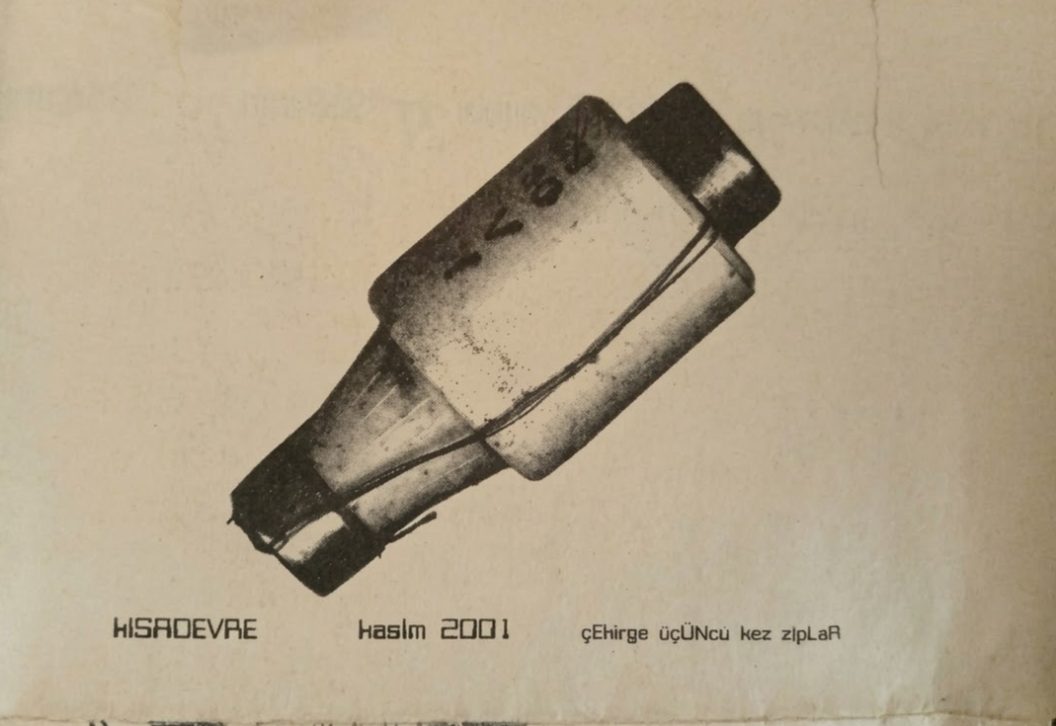
KısaDevre: Video Üzerine Fanzin / 3. Sayı / Kasım 2001 – Ankara
(KısaDevre 2000-2003 yılları arasında video üretiminin politik dilini kurcalayan Ankara’da bir grup tarafından fanzin boyutunda çıkartıldı. 4. final sayısı da kolektif video üretimi ile “Irak’ta Savaş’a Hayır” diyebilmek için 2003 senesinde çıktı. Dördüncü sayı için: https://vimeo.com/1249087202 )
 On Video
Setting out to write a text about video should be regarded as an act contrary to video’s very existence. Damn it! As I reconstruct my troubles, anxieties, and the issues I find myself caught up in through video-films, where does this business of writing about video come from now? If I can put these troubles, anxieties, and issues forward, convey them, explain them through text, why didn’t I write a text in the first place?
1.
Texts
exist to put forward, convey, explain
troubles, anxieties, issues.
They define and develop ways of thinking,
and ultimately impose a particular way of thinking.
They are formulaic!
They repeat themselves,
impose themselves upon troubles, anxieties, issues!
The result: They become instruments for establishing, maintaining and safeguarding order.
Video
exists to find, sense, comprehend
troubles, anxieties, issues
anew each time, in their constant flux, their elusiveness.
It seeks new ways of seeing.
It opens the way to intuition.
It establishes, or at least attempts to establish, an understanding that is constantly being remade (and will continue to be remade), one that cannot be confined to words or text.
The result: It questions order, directs criticism at it, overthrows it. Not in order to establish a new order, but to take aim at every new order that is proposed. Video does not lead to a proposal for order. Video curses!
2.
Do not assume that I am glorifying video. Quite the contrary, video is a despicable thing. I am saying that one cannot get anywhere with video. One thing, however, needs to be realised: There is nowhere to get to in the first place!
[Let no one pin their hopes on utopias. These texts, whose meaning is ‘no place’, always envision a place, even going so far as to design this place in meticulous detail. They sell hope. Hope is the carrot dangled from a stick in front of a donkey.]3.
Do not assume that I place video above the ‘fine’ arts. Video is not merely above them; the moment it finds itself on equal footing with the established arts, it is finished.
All the ‘fine’ arts have, at some point in the course of civilisation’s development, sunk into the mire of order.
Theatre and literature exist in the impasse of text and body. They have no chance of getting anywhere anyway.
Painting and sculpture carry on their lives far removed from the vast majority of society, within their own protected marketplaces (museums and galleries). Even if they share the same concerns as video, they have lost the existential foundations of these concerns within the order.
Photography and cinema have long since become trapped within codes and turned into servants of order.
To regard architecture as an art, on the other hand, is sheer impoverishment. What can be expected of a field that cannot escape the stranglehold of the form-function debate?
Art is nothing but an impoverishment, a narrow-mindedness incapable of offering a way out for either humanity’s present or its future.
Video has the potential to break free from these impasses of art. Not in order to get somewhere, nor to improve life in the world; but to dismantle the stunted forms of life within time and space, forms that are constantly transforming and changing.
4.
At this point, the first question that can be asked is this: What are the potentials of video?
Video is not art!
Video has nothing to do with narrowed, stunted, shallow images! Video constructs the imagination! This is the fundamental source of its potential.
Video ceaselessly produces new ways of seeing, hearing and thinking! It does not produce them in a single form, but in multiple forms.
Video breaks the frame! It accepts no frame, no grading, and therefore no coding or signification. It always spills into a field beyond all of these. And this field is infinite.
Video is unruly! It does not accept the impositions of order; it stands against it, or, failing that, drags its feet, resists, and constructs life in a childlike manner.
KısaDevre (ShortCircuit): Fanzin On Video / 3. Issue / November 2001 – Ankara
(KısaDevre (ShortCircuit) was published in fanzine format between 2000 and 2003 by a group in Ankara who explored the political language of video production. Its fourth and final issue came out in 2003, as a way of saying ‘No to the War in Iraq’ through collective video production. 4. Issue: https://vimeo.com/1249087202 )