Scroll Down for English AI Translation
 Betonlar Arasındaki Ankara Hastaneleri Sözlüğü
Bu sözlük, Ankara’da ve Türkiye’nin çeşitli şehirlerinde farklı gerekçelerle kapatılan devlet hastanelerinin yok edilmeye çalışılan kurumsal hafızasına ve tıp kültürüne ait tanıklıkları kaydederken derlendi. 25 yılda gittikçe artan seviyede yaşanan sağlıkta dönüşümün ve ticarileşmenin son halkası olan şehir hastanelerinin devasa beton bloklarıyla sembolleşen “yepyeni” sağlık anlayışını anlamak amacıyla yapılan sözlü tarih görüşmelerindeki anlatımlardan bu sözlük maddeleri oluşturuldu. Sözler ve izlenimler kişiseldir. Kurumları bağlamaz; ancak duyguları, düşünceleri, kolektif hafızamızı birbirine bağlar ve başka bir sağlık sistemine dair umudu dayanışmanın geçmişiyle canlı tutmayı amaçlar.
10 Ekim 2015: “Numune Hastanesi Acil Servisi Ankara’nın acil yükünü çeken servislerdendi. Bu hastanenin öneminin anlaşılması açısından söylüyorum. 10 Ekim 2015’teki Gar Patlaması sırasında hastaların tamamına yakını Numune Hastanesi’ne getirildi ve o zor zamanların altından Numune Hastanesi Acil Servisi kalktı. Gar buraya 200 metre yakında. Numune Hastanesi bu kadar yakın olmasaydı, mevcut kaybın yarısı kadar artardı. Tüm Numune Hastanesi çalışanları o konuda gerçekten çok büyük bir özveriyle mücadele etti ve onların sayesinde birçok insan kurtuldu.” M.A.
12 Eylül 1980: “12 Eylül 1980’de, sabahleyin bir gürültüyle uyandım. Televizyonu açtığımızda ihtilalin olduğu, sokağa çıkma yasağı ilan edildiği ama bir taraftan da bazı personelin görev başında olması gerektiği söyleniyordu ki biz sağlıkçılar da bunlardan birisiydik. Mutlaka gitmem gerekti. Çünkü yaralı gelirse bizim görevimiz her koşulda hizmet etmekti. Arabama bindim. İlk kavşağa geldim, anında silahlar çevrildi etrafımda. Askerler geldi, sokağa çıkma yasağını hatırlattılar. Ben de kendilerine doktor olduğumu, Numune Hastanesi acilinde görevli olduğumu, göreve gitmem gerektiğini söyledim. ‘10 km’yi geçme. Camların açık olsun. Her taraftan bir şey çıkabilir, dikkat edin.’ dedi. O dikkatle hastaneye kadar geldim. Hastaneye ulaştığımda benim gibi tüm arkadaşlarımın da benzer olayları yaşayarak hastaneye geldiğini gördüm.” Ö.C.
15 Sene: “Aslında şunu anlamış olduk. SSK’nın kapanması ve Sağlık Bakanlığı’na geçişi de bir son değilmiş, bir adımmış. Asıl mesele o hastanelerin hepsinin yıkılmasıymış ve mesela Etlik İhtisas Hastanesi’nin ömrü 15 sene sadece. 15 senede yıkılan bir bina orası. Hakikaten ziyan edilmiş bir binadır. Yanına bir başka hastane yapılabilirdi. Hayır, yıktılar. O dönemin tamamı kapatılacaktı, kapatıldı.” A.S.A.
18 Temmuz 1946: “1945 yılı dünya açısından önemli bir yıldır. Kapitalizm her zaman emekle çatışmasında ya da sürtüşmesinde kazanan taraf olmamıştır. II. Dünya Savaşı sonrasında, özellikle 1946’dan sonra emek güçleri 30-40 yıl her ülkede hâkimiyet kurmuştur. Kazanımlarla dolu yıllardır. Bu yüzden de 18 Temmuz 1946, Ankara’da SSK’nın kuruluş tarihi olmuştur.” E.Y.
19 Şubat 2005: “SSK hastanelerine gelen işçiler ve işçi yakınları, kendilerini kendi hastanesinde tedavi ediyorlardı. Kendi primleriyle bu hastaneler yaratılmıştı. Bir gün bile çalışan işçinin, çalıştıran işverenin o hastanede hakkı vardı. Sağlıkta dönüşüm denilerek işçinin ve işverenin primleriyle kurulan SSK hastaneleri arazisiyle beraber 19 Şubat 2005 tarihinde Sağlık Bakanlığı’na devredildi.” E.Y.
24 Ocak 1980: “Bizim tarih okumalarımızdan bildiğimiz, 1980’de 24 Ocak Kararlarıyla başlayan neoliberalleşme süreci sağlıkta dönüşüm programını başlattı. Dolayısıyla şimdi 28 yaşında bir hekim olarak sağlıkta dönüşüm programının orta yerinden şahidiyim.” D.Y.
40 Dolar: “SSK hastanelerinde bir kişinin maliyeti 40 dolardı. Aynı yıllarda Emekli Sandığı’nın hem devlet hastanelerinden hem de dışarıdan hizmet aldığı sistemde bir kişinin maliyeti yıllık 160, 180 dolara gelirken SSK bunu 40 dolara en iyi hizmet kalitesinde yapıyordu.” E.Y.
56 Dakika: “Bugün 112 ambulansının Etlik Şehir Hastanesi’nden ya da Bilkent Şehir Hastanesi’nden Mamak’a ulaşımı, telefon edildikten sonra 56 dakikaya kadar yükseldi. Halbuki bu bölgedeki hastanelerden ambulans gidebilirdi ve bu süre 15 dakikaya kadar düşebilirdi.” E.Y.
80 Kilometre: “Acil servisin önünde kalp krizinden ölen hasta haberleri çıkmaya başladı. İzmir Şehir Hastanesi’nde oldu yakın zamanda. Bırakın normal poliklinik muayenesini, acil muayene sırası var orada. Çünkü sizi hafta sonları tek hastaneye, herkesin ulaşabileceği en yakın hastaneden ziyade en uzak noktalara yönlendirdiler. İzmir Şehir Hastanesi’ne buradan 80 kilometre uzaktayım. Kalp krizinde benim şehir hastanesine ulaşma sürem ne kadardır ki? En yakın Urla Devlet Hastanesi’ne giderim. Ama anjiyo yapılamaz orada.” R.E.
1.000 Lira: “Vatandaş NATO Yolu’ndan Şehir Hastanesi’ne gitmeye çalışıyor. Dolmuş 40 lira. Şimdi iki dolmuş değiştirse 80 lira, bir kişi. Hasta yanında birini götürür mutlaka. İki kişi gidiyor, geliyor ve 320 lira sadece yola veriyor. Bir de işleri öğleden sonraya kaldığı zaman orada yemek yemesi gerekiyor. Yani 1.000 liraya bir gün hastaneye gitmiş oluyor. Asgari ücretli, emekli nasıl 1.000 lira versin hastaneye gitmek için?” M.A.
1.147 Yayın: “TÜBİTAK’ın verilerine göre 1981 ile 2006 yılları arasında Sağlık Bakanlığı’na bağlı hastaneler içinde en çok bilimsel yayının yapıldığı kurum Ankara Numune Hastanesi’dir. 1.147 yayın ve %17,97’lik bir oranda. Sadece 1997’de 130 yurt dışı yayın yapılmış.” Ö.C.
20.000 Kişi: “Özel işletmelere, şirket hastanelerine belli hasta garantileri verildi. Dolayısıyla hastalar oraya gitmeye bir bakıma zorunlu hâle getirildiler. İzmir Şehir Hastanesi’nde günlük gidip gelen insan sayısının yaklaşık 20.000 kişi olduğu söyleniyor. Bunun trafiğe bile getirdiği yük o bölgeyi felç etmiş durumda. Oraya gidip gelebilme meselesi bile ciddi bir trafik altyapısı gerektiriyor.” M.L.Ç.
40.000 Adım: “Şehir hastaneleri biz hekimler için çalışma koşullarını kolaylaştırmayan, aslında biraz da zorlaştıran bir yapıda. Benim bir gece nöbetimde hastalara ulaşırken bile 40.000 adım atmamın gerektiği, sabah hastaneye girişte kendi kliniğime ulaşana kadar hastane içinde 20 dakika yürümek zorunda kaldığım bir klinikte çalıştım.” G.K.
53.000 İmza: “Onkoloji Hastanesi’nin kapanmaması için ‘Hastanemi Açın’ Platformu ve 122 kurum hepimiz çalışmalar yürüttük. Arkadaşlarımla bu konuda gecemizi gündüzümüze kattık. Sadece yatma zamanı evimize girdik. Meclis’in içinde basın açıklaması yaptık. 53.000 imza topladık. Sağlık Bakanlığı’na verdik. Sağlık Bakanlığı’na vermememiz için polisler bizi tartakladı. Ama biz mücadele ettik ve imzalarımızı Sağlık Bakanlığı’na bırakmış olduk.” A.G.
20 Milyar Dolar: “SSK 1947’de kurulmasından 1970’e kadar emekli vermemişti. 70’li yıllarda SSK’nın o günkü hesaplamalarına göre 20 milyar dolar parası devletteydi. Bu paralar devlet tarafından fabrikalarda kullanıldı ve SSK’ya geri ödenmedi. Daha sonra SSK, kendi işçilerine emekliliğinde vereceği parayı borçlanmak zorunda kaldı.” E.Y.
322 Milyar Euro: “Dönemin Sağlık Bakanı Fahrettin Koca 2023’ün Mayıs’ında giderayak bize çok önemli bir bilgi verdi. ‘Ben göreve geldiğimde şehir hastanelerinin bütçe yükü 322 milyar euroydu. Ben bunu 27,5 milyar euroya düşürdüm.’ dedi. Benim orijinal hesabımsa 81 milyar dolardı. ‘Nereden çıkardın 81 milyar doları?’ diyerek bana kızıyorlardı. Şunu anlıyoruz ki 322 milyar euromuş.” U.E.
Adana Numune Hastanesi: “Adana Numune Hastanesi kapatıldığında 5 yıllık, 750 yataklı, içindeki donanımıyla modern, yepyeni bir hastaneydi. Çünkü hastaların, hasta garantili şehir hastanelerine gitmeleri gerekiyordu. Bir yıl sonra kamuoyu baskısı ve verdiğimiz mücadeleyle Yüreğir Devlet Hastanesi’ni oraya taşıyarak kısmen sağlık hizmetlerini açtılar.” B.İ.
Aile Hekimi: “C. Bey, sağlıklı olabilirsiniz ya da aile hekiminizden haberiniz olmayabilir. Ama sizin gibiler gelip bana muayene olmadığı için bu sene maaşımdan 42 bin lira kesinti yapıldı.” T.Y.
Akşam ve Gece Poliklinikleri: “Ben de birçok meslektaşım gibi ileride bu hizmet kamu hizmeti olarak vermeye devam ettiği takdirde hangi şartlar altında çalışacağımızı bilemiyorum. Bugünlerde akşam ve gece poliklinikleri konuşuluyor. Daha ne kadar emeğimizi ortaya koyarak geçinme çabası içinde kalacağız? Bu soru kafamızda bir soru işareti olarak duruyor hâlâ. Hem geçim sıkıntısı yaşayan hem de şifa dağıtan iki rol tek bir kişide birleşti ve bu da çok mantıklı durmuyor aslında.” G.K.
Albert Eckstein: “Albert Eckstein’ın modern pediatrinin kurucusu olduğu söylenir. Nazi döneminde 1933’ten sonra Almanya’da çalışması yasaklanan Eckstein, Refik Saydam tarafından çalışmalarını Numune Hastanesi’nde sürdürmesi için Türkiye’ye davet ediliyor. Albert Eckstein Anadolu’da 60 köyü ve 20 ili karış karış gezerek bir sağlık raporu hazırlıyor ve Refik Saydam’a sunuluyor. Bu rapordaki öneriler doğrultusunda çocuk ölümlerinde belirgin bir azalma görülüyor o dönemde.” Ö.C.
Anamnez: “Hekimlik öğretisinde hastaya dokunmak, muayene sırasında anamnez dediğimiz konuşma süreci çok önemsenir. Ancak MHRS sistemi ile gelen hastaya ayırabileceğiniz 5 dakikalık sürede bunu yapmanız neredeyse hiç mümkün değil.” G.G.K.
Ankara Suşu: “1970’lerde çiçek hastalığına karşı Refik Saydam Hıfzıssıhha Merkezi’nde geliştirilen aşı, Ankara adını taşıyan en yaygın ve uluslararası bilinen suştur. 2022’de Orta ve Batı Afrika’da yayılan maymun çiçeği virüsüne karşı Dünya Sağlık Örgütü tarafından bu aşı tedavi amacıyla tekrar kullanılmıştır.” C.B.
Asimetrik Bilgilendirme: “MHRS sisteminde hastalar açısından asimetrik bilgilendirme var. Şehir Hastanesi’nde hekim seçme hakkımız var gibi görünse de aslında yok. O sadece yönetmelikte kalmış bir durum. Örneğin uzman doktora muayene olmak için gittiniz Şehir Hastanesi’ne, ama gittiğinizde orada uzman doktora değil o doktorun asistanına muayene olursunuz; çünkü uzman doktor o sırada farklı görevlerdedir ve sizin bunu bilme imkânınız yoktur.” E.K.E.
Asosyallik: “Şehir hastanelerinde sistemle ya da hastalarınla ilgili herhangi bir sorunun nasıl çözüleceğini ve neden böyle olduğunu çoğu zaman kimseyle konuşamıyorsun, tartışamıyorsun. Çünkü sistem seni asosyalliğe itiyor. Bütün gün çalış, hiç kimseyle konuşma, örgütlenme, sorgulama, bir an önce işini bitirip evine gitmeye bak.” G.G.Y.
Ata Soyer ve Fabrika Düzeni: “Türkiye için Şehir Hastaneleri modeli yeni bir model ve şu anda yaşayarak görüyoruz ki sağlık hizmeti üretimiyle, onun niteliğiyle, performans baskısıyla çok ciddi sorunlar doğuruyor. Bunu rahmetli Ata Soyer ‘fabrika düzeni’ diye tanımlamıştır.” G.Y.
AVM Hastane: “Şimdi şehir hastanelerine gidiyoruz, içerisi AVM gibi. Biz oraya canımızla cebelleşerek gidiyoruz ama çevreden simit kokuları, et kokuları geliyor. Orada hele ki ekonomik durumunuz yoksa oralarda nasıl ve kaç gün yiyip içeceksiniz?” F.A.
Ayraç Dergisi: “Tıp fakültesinde okurken Hacettepe Tıp ve Ankara Tıp’taki öğrenciler olarak 2018 senesinde ‘Ayraç’ isimli dergi çıkartmıştık düzenli olarak. ‘Cebimizde öğrenci kartından başka ortak bir şeyler olsun’ mottosuyla çıkardığımız bir dergiydi. Bu dergiyi çıkardığımız zamanlarda Bilkent ve Etlik Şehir Hastanesi açılmamıştı ve derginin 4. sayısında ‘Şehir Hastaneleri Dosyası’ yapmıştık. Bu şehir hastanelerinin belki ilk nesli biz olacaktık. Dolayısıyla bizi doğrudan ilgilendiren bir süreçti ve medyada dahi yüzeysel bilgiler vardı. O günlerde Hacettepe ve Ankara Tıp’taki bütün arkadaşlarımıza olabildiğince bu dergiyi yayarak konuştuk. Amacımız hem çalışan hekim mücadelesi ile biz gençleri bu Şehir Hastanesi mücadelesinde buluşturmamız ve gençlerin de bu mücadeleye katılmasıydı.” D.Y.
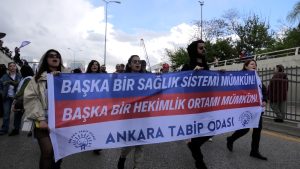
Başka Bir Sağlık Sistemi: “‘Başka bir sağlık sistemi’, 2002’den bu yana süren sağlıkta dönüşümün çökmüşlüğü üzerine tanımladığımız bir şey. Başka bir sağlık sistemi aslında bu çökmüş sistemi toplumcu, kamucu bir bakış açısıyla, sağlıktaki bütün basamakları eğitimden başlayarak yeniden yapılandırmayı içeren bir tanımlamadır.” H.S.B.
Belediye Hastanesi: “Sıhhiye Meydanı’nın sağlıkla ilgili unutulan varlığından bile Ankaralının artık haberdar olmadığı büyük bir Belediye Hastanesi vardı burada. Bu hastane de belediye hastaneleri arasında öncüdür. 2010 yılında, Ankara Büyükşehir Belediye Meclisi’nin aldığı bir kararla Ankara Belediyesi Hastanesi Sağlık Bakanlığı’na devrediliyor. Bundan olumsuz etkilenenlerden birisi de Çankaya Belediyesi oldu. Çankaya Belediyesi’nin ciddi sayıda hekimi vardı. Hekimlerin belediye personeli olmaktan yaşadıkları mağduriyeti dengeleyebilmek için lojman ve benzeri sosyal hakları elde tutmaya çalıştık. Belediyenin 1. basamak sağlık hizmetlerini desteklemesi çalışmalarımızı ne yazık ki baltaladı o süreç.” B.T.
Beyaz Eylem: “1980’li yılların ikinci yarısında Tam Gün Yasası kalkmış, özlük haklarımızın bazıları ihtilalle birlikte kaybedilmişti. Doktorlar neler yapalım diye düşündüler. Sonunda ‘Beyaz Eylem’ dediğimiz eylemleri yapmaya karar verdik. ATO’nun ve TTB’nin başkanlarından Selim Ölçer bu eylemlerin çoğunda birlikte yürüdüğümüz kardeşimdi. İlk eylemimizi, hastanede izin vermedikleri için Etlik Kasalar’da bir yürüyüşle yaptık. Daha sonra Numune Hastanesi bu eylemlerin merkezi oldu. Diğer hastanelerden gelen ekipler Numune Hastanesi’nin bahçesinde birleşir ve oradan Sağlık Bakanlığı’na yürüyüş yapardık. O yürüyüşlerimizde beyaz gömleklerimizi Sağlık Bakanlığı’nın önünde bırakırdık. 12 Eylül sonrası ilk eylemler, beyaz eylemlerimiz olmuştu.” Ö.C.
Bıçak Parası: “Bütün bu süreç, SSK’nın devri, şehir hastanelerinin yapılması sürecine koşut olarak müthiş bir özel hastane üretimine tanık olduk. O bıçak parası diye rahatsız olduğumuz paraların hepsi çok daha büyük miktarlarla özel hastanelerle sermayeye aktarıldı. Türkiye’ye şu söyleniyordu: ‘Bıçak parasından kurtulalım.’ Evet, çok doğru, kurtulalım. Ama geldiğimiz noktada hasta, bunun 50-100 katı bıçak parasını özel hastanelerde hekime değil, sermayeye vermek zorunda kaldı. Yani paranın akacağı tarafı değiştirdiler.” A.S.A.
Bilkent Atatürk Hastanesi: “Bu hastane şimdiki Bilkent Şehir Hastanesi’nin hemen önünde, küçük bir bina olarak inşa edildi. Trafik Hastanesi bütün unsurlarıyla oraya geçti ve orada akademik faaliyetlerin iyi olduğu yeni bir alan oluştu. Çok sayıda asistanımız yetişti. Çok sayıda akademik yayın yapıldı. Ama tabii şehir hastanesinin kuruluşuyla birlikte, bir arkadaşımın dediği gibi bu hastane, şehir hastanesi kompleksinin müştemilatı gibi kaldı. 10 yıllık bu hastane kapatıldı ve Sağlık Bakanlığı’nın hizmet binasına dönüştürüldü.” İ.C.
Bursa Şehir Hastanesi Metrosu: “Çok ilginçtir, Bursa Şehir Hastanesi’nin maliyetinin 400 milyon dolar olduğunu söylediler. Bursa Belediyesi oraya metro çalışmasını 600 milyon dolara yapıyor. Hastane ücretinden daha fazlasını hastaneye ulaşabilmek için ödüyoruz. Oysa kentin merkezinde o hastaneyi kapsayacak kadar kamu alanı vardı. Ancak çok merkezî yere hastane yapmak yerine stadyum yaptılar. Bu stadyum da yılda 20 kez kullanılıyor.” K.B.
Defansif Hekimlik: “Şu anda hekimlerin ve genel olarak sağlık çalışanlarının geleceğe dair yaşamsal kaygıları o kadar büyük ki… Artık örgütlenmeyi, meslekleri için veya halkın sağlık hakkı için bir şeyler yapmayı ayrıca bir risk olarak gördükleri için mesleğini icra ederken, yani tedavi sürecinde bile daha çekingen davranmaya yol açan bir sistemin içinde olduğumuz defansif hekimlik diye bir kavram ortaya çıktı.” G.B.G.
Demiryolları Hastanesi: “Annem Demiryolları Hastanesi’nde doğum yapıyor ve bahçeye atıyor göbeğimi. Bahçeye attığı için tabii, ben de burada hemşire olarak işe başlıyorum ve emekli oluncaya kadar 40 yıl bu hastaneye hizmet ediyorum.” G.B.
Dışkapı Ruhu: “Dışkapı Eğitim ve Araştırma Hastanesi’nde mesleki tatminimiz çok yüksekti. Sürekli tıp eğitimi, branşa ait eğitim vardı. Birbirimizin eksiğini tamamlardık. Uyumlu bir klinik olarak Dışkapı’da zevkle çalıştık. Çünkü orada bir ruh vardı, ‘Dışkapı ruhu’ deniliyordu. Hasta yararına, bütün hekimler birbirine danışarak, konsültasyon yaparak, liyazonlar oluşturarak, mesleki tatmini yüksek bir şekilde çalıştık. Çok verimliydi. Ağır, ciddi vakalar alıyorduk, iyi bir seviyeye getiriyorduk.” D.E.
Dışkapı’dan Sürülmek: “Dışkapı Hastanesi kapatılınca çoğu arkadaşım işten çıkarıldı. Çıkartılmayanlar da çok uzak yerlerde görevlendirildiler. Mamak’ta oturan ve Dışkapı Hastanesi’nde çalışan temizlik görevlisi arkadaşım şimdi Gölbaşı Hastanesi’ne gidiyor ve yola saat 06.00’da çıkıyor. Gölbaşı’na gidene kadar saat 07.30 oluyor ve hemen işbaşı yapıyor. Böyle zorluklar yaşadıklarını söylüyorlar. Yönetici kadroda tanıdıkları olmadıkları için daha zor işlere gitmek zorunda olduklarını anlatıyorlar. Tabii ki mecburen çalışmaları gerekiyor.” N.O.
Direnen Hafıza: “Şehir hastaneleri için kapatılan bu hastaneleri bilmeyen, o hastanelerde çalışmayan genç hekimler var aramızda. Bu hastanelerde çalışmanın ne olduğunu hayal bile edemeyen hekimler var. Onlara ulaştırmaktı aslında bu belgeleri, videoları çekme amacımız. İzleyiciyi düşünmeye, sorgulamaya, pozisyon almaya teşvik etmeyi hedefledik. İnsan hikâyeleri üzerinden izleyicilerle bağ kurmayı, duygusal bağ kurmasını sağlamaktı amacımız. Görünmeyeni görünür kılmaktı. Şehir hastaneleri inşa edilirken bir kent hafızası yıkıldı ama hafıza direnir. Bu belgesel o direnişin belgesidir.” K.O.
Distopya: “Öğrenciyken yine insanların kendini ifade edebildiği alanları oluyordu. Ama şehir hastanesinde buna dair hiçbir şey yok. Senin belli başlı iki tane seçeneğin var: Ya onlar gibi düşüneceksin, bulunduğun kliniklerde sorumlu ya da şef olursun; ya da sürüneceksin. Başka bir alternatif üretme şansın yok. Önemli olan gelen komutları harfiyen uygulamak. Bir distopya gibi. Korkutucu olan kısmı da bu zaten.” K.D.
Dünya Bankası: “Sağlıkta dönüşüm 1990’larda başladı. Dünya Bankası inisiyatifiyle ve oradan gelen hibeyle başlayan bir süreçti. Bakanlık içinde büyük örgütlenmeler vardı ama koalisyon hükümetleriyle bunun gerekleri olan yasal değişiklikler yapılamadı. Sonunda hepimizin bildiği gibi AKP’nin iktidara gelmesiyle, tek parti iktidarı olduğu için Dünya Bankası’nın ve diğer ülkelerin yaptırımıyla yasal değişiklikler de gerçekleşti ve hükümetin de politikalarına uyduğu için bu dönüşüm hızla sistemimize hâkim olmaya başladı.” G.E.
Eksik İmtiyaz: “Şehir hastanelerinde inşaat firmasının imtiyazı, ki eksik imtiyaz diye tanımlanabilir buradaki süreç, hastanenin sağlık hizmeti dışındaki tüm hizmetlerini alt taşeronlara istediği gibi taşere edebiliyor.” G.K.
Etlik İhtisas Hastanesi’nin Helikopter Pisti: “Etlik İhtisas Hastanesi’nde helikopter pistimiz vardı. 2008’de hava ambulansı başlamıştı. 2011’in sonlarında hastane kapatıldı. Yani 3 yıl bile hayatta kalmayan bir helikopter pistine bu kadar yatırım, bu kadar para… Sonuçta devletin parası, bizim paramız değil mi?” R.A.
Etlik Zübeyde Hanım Doğumevi: “Etlik’te yeşillikler içerisinde, çok güzel bir hastaneydi. Hastalarımız ve çalışanlar için çok güzellikleri olan bir hastaneydi. Hastaneye büyük bir sevinç ve amatör ruhla giderdik. Bu durum sağlıkta dönüşüm dediğimiz Sağlık Bakanlığı ve SSK hastanelerinin birleştirilmesi dönemine kadar devam etti. Performans sistemi yoktu o zamanlar. Performans sisteminin gelmesiyle birlikte bu ahenk bozuldu.” R.Ö.
EYT (Etlik’te Yaşa Takılanlar): “Şehir hastaneleri 2022 yılının sonlarında açıldığında topluca Etlik Şehir Hastanesi’ne geçiş yapıldı ve Dışkapı Hastanesi’nin kapatılacağı söylendi. Daha sonra toplumdan görülen tepkiler üzerine ben de dâhil bazı 60 yaş üzeri doktorlar tekrar Dışkapı Hastanesi’ne geri gönderildi. O zaman espri yapmıştım ‘EYT’liyiz’ (Etlik’te Yaşa Takılanlar) diye. Genelde dönenler 60 yaş üstü doktorlardı ama Dışkapı Hastanesi’nin de içi boşaltılmıştı. Bütün sarf malzemeleri, tıbbi cihazlar, her şey alınmıştı. Sadece sağlık ocağı merkezi gibi poliklinik yapacak şekilde bırakılmıştı.” N.Ö.
Finansman Projesi: “Bu hastaneler bir finansman projesi. İhaleye tabi olan şirketler açısından uluslararası finansman yüklenicisi bulmadan yapılamayacak projeler. Dolayısıyla aynı zamanda uzun vadede finansmanı sağlayan kuruluşun gelir garantisi bu projeler ve burada geri ödeme açısından da çok yüksek borçlanma söz konusuydu. Devlet borçlansa daha düşük faizle borçlanabilir. Şirket borçlandığı için daha yüksek faizle borçlanıyor ve devlet de bu sözleşmeler yoluyla şirketlerin ödemelerini garanti altına almış oluyor. Kuvvetli bir siyasi tercihin sonucudur nihayetinde.” Ö.E.
Genel Sağlık Sigortası Yasası: “2008 yılının ağustos aylarında GSS Yasası dediğimiz, Sosyal Güvenlik Yasası değiştirildi ve inanılmaz köklü değişiklikler yapıldı. Hem sağlıkla hem de emeklilik alanında maaş bağlama oranlarından, sağlık sisteminin bu hâle getirilmesine kadar bir dizi düzenleme o yasayla yapıldı. Bugün emekli maaşlarının bu derece düşük olmasının nedeni de bu yasadır.” S.Ö.
Gömleklere Çip Takmak: “Mersin Şehir Hastanesi’nde gömleklere çip takmaya kalktılar. Sonra da ‘Kıyafetler çamaşırhanede kaybolmasın diye yapıyoruz.’ dediler. Ama orada bir güvenlik çalışanı belirlenen mesafenin dışına çıktığı için onun işini sonlandırdılar.” Ö.E.
Gureba Hastanesi: “Numune Hastanesi’nin müthiş bir tarihî değeri var. Kuruluşu 1881. O tarihte Taş Pavyon adında bir bölümü yapılmış ve ismi Guraba Hastanesi. Gariplere, kimsesizlere bakan bir hastane. Sonra Kurtuluş Savaşı sırasında Ankara’da savaşta yaralananlara çok büyük hizmet veren bir yer orası. 1920-1924 arasında Ankara Mülkiye Hastanesi olarak ismi geçiyor. 1924’te bir kanun çıkarılıyor ve Ankara Numune Hastanesi ismini alıyor.” İ.C.
Hakan Tosun: “Çevre sorunlarıyla ilgili haber yapan bir gazeteci arkadaşımız Hakan Tosun, gece vakti Esenyurt’ta, şehrin merkezindeki bir ilçede dövülerek öldürüldü. Ağır bir travma geçirdi ve şehrin dışındaki Çam ve Sakura Şehir Hastanesi’ne getirildi. Bu hastanede acil servise alındı. Ama acil servise alındıktan sonra durumun çok ağır olduğu anlaşıldı, konsültasyon yapıldı, tomografiler çekildi, her şey yapıldı ama arkadaşımız için hemen bir yoğun bakım yatağı bulunamadı ve Hakan Tosun’u kaybettik. O kadar büyük bir hastane yapıyorsunuz, o kadar yoğun bakım yatağınız var diye anlatıyorsunuz ama bunu şehre ve ulaşılabilir yerlere yaymanız gerekir.” O.K.
Hastane Kreşi: “Annem SSK Dışkapı Hastanesi’nde çalışıyordu. O zaman da kurumun çalışanlarının çocukları kurum kreşine gidebiliyordu. Benim de çocukluğumun çok önemli bir kısmı o kreşte ve hastanenin içinde geçti aslında. Bugün bir hekim olarak, bir kadın olarak dönüp baktığımda aslında o kreşin sadece öyle bir ortamdan ibaret olmadığını görüyorum. Ebeveynlerin, özellikle kadınların çalışma yaşamında kalabilmesini mümkün kılan bir eşitlik ve dayanışma ortamıydı.” G.B.G.
Hekimin Moral Yaralanması: “Çocukluğumuzdan beri aklımızda bir hekim profili var: Şifa dağıtan, özveriyle çalışan, tıp fakültesinde o özveriyle okumuş olan hekim. Öyle yetişiyor ama daha sonra içine düştüğü bu piyasacı sağlık sistemi, şehir hastaneleri, özel sektördeki durum ve çalışma koşulları sonucu kafasındaki değerlerle uyuşmayan bir ortamın içine sürükleniyor. Bu hekimin kendi içinde taşıdığı değerlerle, içinde yaşamak zorunda kaldığı ortam arasında açılan o makas hekimin moral yaralanmasına sebep oluyor.” B.İ.
Her Şeyin Başı Sağlık: “Şehir hastanelerine ödenen kiraları veya diğer bedelleri duydukça dudaklarımız uçukluyor. Hastanemi Açın Platformu’nda ‘Her şeyin başı sağlık’ sloganı, bizim başlangıçtan beri kullandığımız ifadelerden biriydi. Her şeyin başı sağlık olsun, soygun olmasın.” Z.Y.
Hôtel-Dieu Hastanesi: “Tanrı’nın Evi anlamına geliyor. Kuruluş için 651 tarihi veriliyor. Neredeyse 1.400 yıllık geçmişi olan bir hastaneden söz ediyoruz. Kuşkusuz yıllar içinde işlevlerinde dönüşümler olmuş, yıkılmış, yanmış, hep yeniden yapılmış ve sağlık hizmetleri sunmaya devam etmiş. Savaşlara, isyanlara, veba salgınlarına, devrimlere tanıklık etmiş. Yeri Notre-Dame Katedrali’nin yanında, Seine Nehri’nin kıyısında. Sanırım arsa değeri pek yüksek. Kimsenin aklına burayı AVM ya da otel yapmak, hastaneyi de şehir dışına taşımak gelmiyor.” B.İ.
Hygieia: “Hıfzıssıhha Müessesesi’nin girişinde Sağlık Tanrıçası Hygieia’nın heykelinin bulunduğu binada ülkemizin halk sağlığı uzmanları en iyi şekilde yetişmiştir. Burada yetişen halk sağlığı uzmanları ülkemizin il sağlık müdürleri ve müdür muavinleri olarak hizmet etmişlerdir.” C.B.
İlk Kalp Nakli ve Koroner Anjiyo: “Türkiye’de ilk kalp naklini Kemal Bayazıt Yüksek İhtisas’ta gerçekleştirdi. İlk koroner anjiyoyu Yüksek İhtisas’ta kurucusu olan Mehmet Özdemir yaptı. O hastanede biz insanlığı öğrendik. Hastalarımız için özveriyle çalışılır, tanıların en doğrusu orada konulurdu. Yüksek İhtisas’ın kapatılması benim içimi çok acıtıyor.” A.Ü.
Kalite Çemberi: “1998’de Zekai Tahir Burak Hastanesi’ne geldiğimde sağlıkta kalite uygulamaları, ISO 9001 belgesini alabilmek çok önemli bir hedefti. Bunu ilk defa burada görmüştüm ve o dönemki başhekim de bu konuda son derece geniş vizyonu olan bir başhekimimizdi. Çok kısa bir süre sonra ‘Kalite çemberlerine dâhil edelim seni.’ dediler ve kabul ettim. Katıldığım toplantılarda meslektaşlarım, verdiğimiz hizmetin alanlara bölünmüş olarak nasıl daha iyileştirileceği ile ilgili fikir alışverişleri yapıyorlardı ve bu gerçekten de mesleğim açısından, bir sağlık çalışanı olarak güzel bir şeydi.” B.E.
Kamu-Özel Ortaklığı / İş Birliği: “Şehir hastanelerine ‘Kamu-özel ortaklığı’ diyorlardı başlangıçta. Sonra benim katkımla da ‘iş birliği’ olarak çevirdiler. Çünkü ortaklık olması için amaç fonksiyonunuzun aynısı olması lazım. Ben devletsem, en kaliteli sağlık hizmetini vatandaşıma kaliteli ve mümkünse bedava, değilse de çok ucuza sunmam gerekiyor. Özel ortaksa kâr amacıyla çalışıyor. Onun derdi minimum maliyet ve maksimum fiyat. Dolayısıyla amaçlarımız bir değil.” U.E.
Kaybolan Hasta Arşivleri: “Yıllarca Dışkapı Hastanesi’nde takip edilmiş bir hastamız, artık orası olmadığı için, Bilkent Şehir Hastanesi’nin sisteminde bir epikrizi yok. Hasta için daha önce ne yapılmış, düşünülmüş; bu arşivler de yok olmuş. Bu hastanelerin bütün o kültürü, ekolü, bilgi birikimiyle birlikte aslında hastaların geçmişi, arşivleri de kaybolmuş durumda. O yüzden hastalar da kendilerini anlatamayacak durumdalar.” G.D.D.
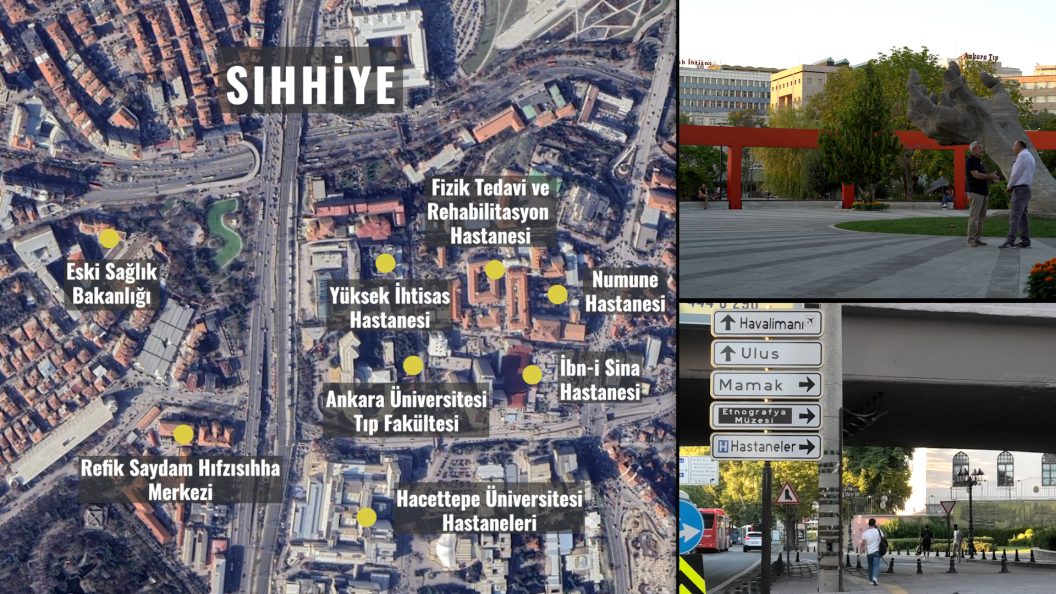
Kent Merkezi: “Kent merkezini öldürmese de bayıltan şeylerden birisi, Sıhhiye’deki hastanelerin kapatılması oldu. Hastaneler geceleri uyumayan işlevlerdir. AVM’ler hangi saatte olursa olsun, kapanır. Restoranlar kapanır. Meyhaneler bile kapanır ama hastaneler kapanmaz. Orası ayrıca insanların kolay gelip gideceği bir yerdir. Kent merkezlerinde sağlık kuruluşlarının olması, sadece aydınlık ve yaşayan, 24 saat hizmet sunan bir yer olması açısından değil, kolay erişim açısından da büyük önem taşıyor.” B.T.
Kışkırtılmış Sağlık ve İnşaat: “Kent merkezindeki hastanelerin işlevsiz kılınması, arsalarının değerlendirilmesi adına inşaat sektörünü esas alan, her şeyin yapısını daha büyük, daha heybetli yapma üzerine ekonomi çarkını döndürmek isteyen bir ekonomi anlayışının ürünü olarak görülebilir şehir hastaneleri. Sağlık sektöründe ilaç ve tedavi hizmetleri nasıl kışkırtılıyorsa, inşaat sektöründe de aynı şekilde devasa hastaneler yapıyorsunuz.” B.T.
Kolera Aşısı: “Refik Saydam Hıfzıssıhha Müessesesi’nde ürettiğimiz kolera aşılarının bir bölümü, 1937 yılında Çin kolera salgınına, daha sonra 1948 Kahire kolera salgınına Kızılay’ımız aracılığıyla gönderilmiştir.” C.B.
Konsültasyona Giderken Kaza Yapmak: “Ulus Devlet Hastanesi’nde konsültasyonlar çok rahattı. Yan odamda kulak burun boğaz uzmanı vardı. Birbirimizle dakikalık iletişim hâlinde olabiliyorduk. Bir dakikada konsültasyon hallediliyordu. Şimdi, şehir hastanelerinde bir hekim, konsültasyona arabasıyla giderken kaza geçirmiş. Bir-iki dakikada konsültasyonun yapıldığı zamanlardan bu duruma geldik.” M.C.
Küçük Zararsız Tanılar: “Artık hekimler hastaya ‘sağlamsın’ı çok zor diyorlar. Çünkü eğer bu kısa süreli muayenede hastada bir bulguya ulaşamadıysa ve akabinde hastaya bir şey olursa ‘Ben geldim, sen bana bir şeyin yok dedin. Ama bu hastalığım ortaya çıktı.’ diyebilir hekime. Küçük, zararsız tanılar konuluyor bu yüzden.” M.C.
Makbul Vatandaş: “Şehir Hastanesi’nde kaybolmamak için başım öne eğik, sürekli yeşil, sarı, mavi çizgileri takip etmem gerekiyor. Sanki tam da iktidarın istediği makbul vatandaş gibi, devasa bir binada yolumu bulmaya çalışırken başım öne eğik… Bu duruma çok öfkelendiğimi anımsıyorum.” T.G.K.
Mavi Kod: “Mavi kod çalınca, yani hastanede acil bir durum olduğunda bir doktor ya da iki doktor hemen oraya gider, ilk müdahalesini yapar. Çalıştığım hastane dokuz katlı. Bazen mavi kod çalıyor. Eğer ki ben o gün nöbetçiysem, mavi kod 8. katta çalıyor. Ben -1. kattayım. Benim sadece o kata ulaşmam 10 dakika sürüyor. Merdivenleri koşarak çıksam yine yetişemem.” K.Y.
Mavi Yakalı İşçiler: “Hekimler de aslında artık günümüzde mavi yakalı işçiler oldular. Çünkü kendi çalışma yöntem sürelerini ve ritimlerini kendileri belirleyemiyorlar. Kazancınızın %70’ini performansla elde ettiğinizde, performansa dayalı kazancınız emekliliğinize yansımadığında, o süre baskısını siz daha fazla hissediyorsunuz ve bununla başa çıkmak çok zor oluyor. Bir kısır döngü yaşanıyor. Hekimler hastalandıklarında ve hasta bakamadıklarında performansları düşüyor, gelirleri azalıyor.” M.Y.M.
Mega Proje Literatürü: “Çalıştığım mega proje literatürü der ki: ‘Büyük projelerin %90’ı hatalıdır, iyi sonuç vermez.’ Başarıdan beklentimiz şudur: Öngörülen bütçe içerisinde yapılacak, öngördüğünüz zamanda bitirilecek. Bir şeyi, ‘dünyanın en büyüğünü ve ilk defa ben yapıyorum’ derseniz siz bu işi bilmiyorsunuz demektir. Bilmediğiniz bir işe soyunuyorsunuz.” U.E.
Memleket Hastanesi: “Bursa’da şehir hastanesi açıldıktan sonra merkezde olan bir hastane dışında bütün hastaneler kapandı. Göğüs Hastalıkları Hastanesi, Kadın Doğum Hastanesi, hatta tarihî özelliği olan Memleket Hastanesi kapatıldı. Memleket Hastanesi binası hâlâ duruyor, ne yapacaklarını bilmiyorlar.” G.E.
Muayene Fişi: “SSK hastaneleri döneminde grev yapabiliyorduk. Eskiden polikliniklerde hastaların muayene fişleri vardı. Muayene fişlerini alan arkadaşımız iş bıraktığı zaman, biz de iş bırakmış olurduk ve böylece grev yapardık.” E.K.E.
Numuneli Olmak: “Son derece karmaşık, kalabalık ve son derece zor hastaların başvurduğu bir hastanedeki kadrodan biri olmak ilk başta insanı ürküten bir şey gibiydi ama her zaman çok kolaylaştırıcı yanları da vardı. Çünkü bir kere sahiplenme duygusu vardı. Numuneli olma aidiyeti hâlâ vardır bende ve hâlâ o hastanenin önünden geçerken, en yakınını kaybetmiş birinin geriye dönüp onun yattığı yatağa bakması gibi hisler duyuyorum. Bu benim açımdan çok acıklı ve mümkün olduğu kadar geçmemeye çalışıyorum oradan. Bizim duygularımız, bozulan bu sağlık sisteminin arkasından ağlamak gibi. Bir binanın arkasından ağlamak değil.” N.U.
Numunespor: “Numune Hastanesi’nin bir spor kulübü de vardı. Bu spor kulübünün de bir dönem başkanlığını yaptım. Spor kulübümüz Ankara Amatör Futbol Ligi’nde birinci olunca Türkiye 3. Ligi’ne yükselme maçlarına katıldık. Kadın voleybol takımımız ise bugün için Sultanlar Ligi dediğimiz 1. Lig’e kadar çıktı. Sonra kulüp başka firmalara devredildi.” Ö.C.
Nitelikli Denetim: “Yatırım tahkimine gitmeden ve tazminat ödemeden şehir hastaneleri için imzalanan sözleşmelerden rahatlıkla kurtulabiliyoruz. Planlamacı Uğur Emek’e göre nitelikli denetimle bu mümkün. Kamu-özel ortaklığı modelinin iyi ve uygulanabilir bir model olduğunu söyleyen çevrelerin kendi içinden ürettiği bir yaklaşım bu. Diyor ki: ‘Bu ihaleyi alan şirketler, sözleşmeye ve sözleşmedeki taahhütlerine uyuyorlar mı? Hizmetleri sözleşmedeki kriterlere uygun yapıyorlar mı?’ Sözleşmelerde ceza puanları var. Belli sürelerle bu işlerin yapılmaması hâlinde uzayan sürelerle ilgili yaptırımlar var. Hastanede bir sorun çıkması hâlinde sözleşme feshi nasıl yapılıyor, ayrıntılı taslağı var. Dolayısıyla bu sözleşmelerin hem parçalanan hizmetlerin tek tek denetlenmesi hem de bütününe dair bu sözleşmenin nasıl feshedilebildiğine dair bir mekanizma içinde tanımlı.” Ö.E.
“Onkoloji Hastanesini Kapatma” Platformu: “‘Hastanemi Açın’ Platformu’nun çalışmaları sürerken sadece Onkoloji Hastanesi’ne yönelik ‘Onkoloji Hastanesini Kapatma’ platformunu da kurduk. Şunu anladık ki, hangi görüşten olursa olsun eğer halkı arkanıza alırsanız, kendinize inanırsanız ve halkı inandırırsanız, yaparsınız. Bu platformun çalışmaları ülkenin zor zamanlarında bile umudumuzu tazeledi. Biliyorum ki inanan kişiler yan yana geldiğinde, 7/24 zihnini bu işe çalıştırdığında, bütün gücünü verdiğinde bir şekilde mücadele kazanılıyor.” F.A.
Otopark: “Ulus Devlet Hastanesi Ana Binası SSK’nın ilk dispanseri olarak hizmet vermeye başladığı 1945-1950’li yıllarda iki katlı, taş yapılı bir binaydı. Tamirat, tadilat bile yapılamazdı. Çünkü kültür ve tabiat varlıkları bakımından koruma altına alınmış bir binaydı. Düşünebiliyor musunuz, şimdi bu bina bile yerinde değil. Hastane binasının olduğu alan otopark olarak kullanılıyor.” A.A.
Özel Hastaneler: “Neden özel hastaneler devasa boyutlarda değil? Ankara’da şehir hastanesi gibi iki tane devasa özel hastane olsun, herkes oraya gitsin. Neden bu kadar büyük olmayan ve neredeyse tam teşekküllü özel hastaneleri her köşe başına yapıyoruz da, Ankara gibi Türkiye’nin, Cumhuriyet’in başkentine iki tane, İzmir’e bir tane şehir hastanesi yapıyoruz? Neden özel hastaneler bu kadar kolay ulaşılabilir?” R.A.
Pandemi Dönemi: “Pandemi döneminde de büyük hastanelerde bulaş riskinin çok daha arttığı anlaşıldı. Pandemide ağır vakalar oldu, odanın havalandırma sisteminde o enfeksiyonun başka yerlere bulaşma riskinin çok arttığı söylendi. Biz de defalarca bunun haberini yaptık. Camı açıp odayı havalandıramadığımız bir binada oluyorsunuz şehir hastanelerinde.” S.Ö.
Protez Atölyesi: “Ankara Rehabilitasyon Eğitim ve Araştırma Hastanesi’nde hastalar için protezin ve özellikle ortezin üretildiği bir atölye vardı. Atölyeye inip teknisyenlerle, ustalarla konuşup hastalara ortez yaptırırdık, denerdik. Protez atölyesini şimdi yeni hastanelerde görmüyoruz.” D.E.
Refik Saydam ve Hıfzıssıhha: “Ben Hıfzıssıhha’da çalışırken Refik Saydam’ın hokkalığı benim masamdaydı. Ben o hokkalığı emekli olurken, hocam halk sağlığı profesörü Fatih Kara’ya teslim ettim. O hokkalığı düzelterek masasına koydu. Kütüphanenin yanında Refik Saydam’ın sümen takımı, arkasında cübbesi vardı. Onlar yok ama hokkalığını ben koruyabildim ve teslim ettim. Sadece bu kadarını söyleyeyim.” C.B.
Rekabet: “Bir hekim eğitimini şöyle alır: Bir hasta gelir bana, bu hastaya ben çok yakınımmış gibi bakmak zorundayım. O hasta çünkü ve hekim için kıymetlidir. Ne şikâyeti var, onu dinlerim. 10 dakika vakit ayırırım, gerekirse 15 dakika, ilgilenirim o hastamla. Ama bunu yapma şansın yok. Bilkent Şehir Hastanesi’nde ulaşılması gereken bir sayı var. O sayının da bir rakibi var Ankara’da. O rakip de Etlik Şehir Hastanesi. Bilkent’in sayıları Etlik’in sayısını yakalamalı. Bilkent Etlik’i geçtiği zaman da bu sefer Etlik’tekiler diyecek ki: ‘Bilkent bizi geçmiş, biz niye bu kadar bakamıyoruz arkadaşlar?’ Bu aslında sonsuz bir beklenti. Bugün 50 X iş yap. Etlik 52 yapsın, sen 55 yap. Bu hep böyle artarak gider: 57, 60, 65, 70. Sürekli bir yarış içindesin, istatistik üreten büyük bir mekanizmasın.” K.D.
Rümeysa Berrin Şen: “Şehir hastanelerinin yol açtığı en büyük sıkıntı olan esnek çalışma saatlerinin sonuçlarından biri Rümeysa Berrin Şen arkadaşımızın vefatı oldu. Bilkent Şehir Kadın Doğum Hastanesi’nde 36 saatlik bir nöbetten sonra trafik kazası geçirerek vefat etti. Keşke 260.000 hekim şu an örgütlü olabilsek ve böyle arkadaşlarımızın vefat etmesi önlenebilse.” D.Y.
Sadakat: “Devlet hastaneleri kliniklerinde şef, şef yardımcısı ya da başasistan olmak istiyorsanız bunlar birer sınava tabi idi. Sonra bu sınavlar maalesef kaldırıldı. Kaldırıldıkça liyakatten başka unsurlar, şimdi buna ‘sadakat’ deniliyor, devreye girdi. Oysa daha önce bu tür görevlere gelen insanlar ciddi bir filtreden geçiyorlardı ve bu hakikaten çok yararlı oluyor idi.” İ.C.
Sağlık Turizmi: “Bu şehir hastanelerinin bir diğer gerekçesi de sağlık turizmi. Yani yurt dışında tedavi olmak isteyenleri Türkiye’ye, buradaki daha ucuz iş gücüyle dışarıdan bu parayı çekmek. Hastanelerin VIP kısımlarını da gezmiştim orada çalışırken. Hiç olmayacak şekilde hastanede her yer laminant kaplı. Hastanenin tıbben laminant kaplı olmaması gerekir. Her odanın içinde dört oda açılıyor. İçinde buzdolapları, yaşam alanları, televizyonlar var. Bir hasta odası değil de bizim paramızı verip gidemeyeceğimiz fiyatlarda bir otelin hastane versiyonu gibiydi.” Ü.Y.Ö.
Sağlıkta Şiddet: “Şu anda hekimler kendi başlarına bir poliklinikte günde yüzlerce hastaya bakıyorlar ve hiçbir şekilde tatmin olmuyorlar. Aslında bilinçli bir şekilde bu hâle getirildik. Bizi kendi içimizde yalnızlaştırıp hastayla baş başa bırakıp çaresiz duruma getirmeye çalışıyorlar. Sağlıkta şiddet mesela en basitinden bunun örneğidir. Tek başına çalışan bir hekim, özellikle kadın hekimler çok daha şiddete, fiziksel olmasa da sıkça sözel şiddete maruz kalıyorlar.” N.E.
Sami Ulus ve Çocuk Hastanesi: “Beni Çocuk Hastanesi’ne tayin ettiler. Ulus’ta ara sokakta ev gibi küçücük bir binaydı. Ama 50-60 kişilik bir ekiptik ve başhekim de doktor Sami Ulus’tu. Orada ben hocayı tanıdım. Sonrasında bir yer belirlendi ve şimdiki hastanemiz oraya inşa edildi. Rahmetli Sami Ulus bizi alırdı, 5-10 doktorduk. Her sabah giderdik inşaat yerine ve aramızda konuşurduk: ‘Nereye kadar yapıldı, inşaat büyüdü mü? Biz nerede oturacağız, nerede hasta bakacağız?’ Zamanla binanın inşaatı bitti. Çok güzel bir binaydı ve biz oraya taşındık.” N.Ü.
Sayıları Tedavi Etmek: “Artık hastanelerin çoğu zaten sadece hizmet üretiyor. Burada Sağlık Bakanlığı’nın istediği şey, sadece belirli sayıda hastanın gelip muayene olması ve belirlenen sayıda hastanın da ameliyat olması. Sadece sayıları konuşuyoruz. İşin niteliği hakkında hiçbir değerlendirme yok. Hiçbir bilgimiz yok. Bu nedenle aslında sadece sayıları tedavi ediyoruz, maalesef bu durum eğitime de çok etki eden bir süreç.” D.Y.
Sıhhiye: “Ankara Numune Hastanesi, Türkiye Yüksek İhtisas Hastanesi, Fizik Tedavi Hastanesi, Hıfzıssıhha Merkezi ve Sağlık Bakanlığı, bunların hepsi Ankara’da kent planlamasında Sıhhiye’yi oluşturuyordu. Sıhhiye ne demek? Sağlık hizmetlerinin verildiği merkez demek. Siz Sağlık Bakanlığı binasından çıkıyorsunuz, ki Cumhuriyet’in sembolü tarihî binalardan bir tanesidir Sıhhiye’deki bina ve Bilkent Şehir Hastanesi’nin yanındaki dışı cam kaplı bir binaya kiraya çıkıyorsunuz.” B.İ.
SSK İlaç Fabrikası: “Herkes SSK hastanelerini ilaç kuyruklarından dolayı kötülerdi 1990’larda. Oysa SSK’nın ilaç fabrikası bile vardı. Düşünün ki jeopolitik konumdadır ilaç sektörü. Antibiyotiği siz üretirsiniz. Patent yasası da 2010’da çıktı. Devasa bir kartele, ulusötesi şirketlere ilacından, cihazından, hastane sisteminin hizmet sunumuna kadar uluslararası yapılara para ödeyen bir ülke ekonomisi hâline getirdiler sistemi. Yanılttılar bizi. ‘Bu kuyruklar çok’ diyerek eczaneleri dışarıya çıkardık. Ama bu arada patent yasasını çıkardınız ve ilaç fabrikasını neden kapattınız?” R.A.
Şükrü Yusuf Sarıbaş: “Şimdi ben muayeneye hasta olarak gitmek durumunda kaldığım zaman, doktor olarak hissettiğim, şikâyetin tam dinlenmeden tetkikler istenmesini bazen çok gerekli görmüyorum. Ankara Tıp Fakültesi’nde 1950’lerde hocamız Şükrü Yusuf Sarıbaş’tı. Derslerinde ‘Doktorun tansiyon aleti, dinleme aleti, stetoskopu, refleks çekici olacak, muayeneye bunlarla başlayın.’ derdi. Doktorlar için, şimdi işinin çokluğundan belki de, tetkikleri önden istemek daha makul oluyor.” B.K.
Tam Gün Yasası: “1978’de çıkan Tam Gün Yasası’nın ufak tefek arızaları, yanlışlıkları düzeltilerek devam etseydi, bugün Türkiye’de sağlık sorununun kalmayacağını düşünüyorum. Bugünkü dönüşümlere, hiçbir şeye gerek kalmayacaktı. Maalesef, 1978’de çıkan bu yasa, 12 Eylül 1980 ile birlikte ortadan kaldırıldı.” Ö.C.
Tavşan: “Dışkapı SSK acilinde gece vakti kalabalığın içinde biri kucağında tavşanla bekliyordu. Tavşanı neden getirdiğini sorduğumda, ‘Tavşanım hasta, muayene eder misiniz?’ dedi. ‘Tavşanın SSK’lı olduğunu düşünmüyorum. Onu devlet hastanesine götürmen gerekebilir.’ diyebilmiştim.” A.S.A.
Teletıp: “Etlik Şehir Hastanesi’nin içinde fizik tedavi rehabilitasyon hastanesi var. Göğüs Hastalıkları Kliniği’nden yatalak felç hasta için bir konsültasyon istendiği zaman konsültan hekim o gün kalkıp oraya gidemiyor. Mesafeler uzak. Bilgisayarından o hastanın PA akciğer grafisine bakıyor ve notunu düşüp konsültasyonu kapatıyor. Yani aynı hastane içinde ‘teletıp’ yapıyor. Oysa Dışkapı Hastanesi’nde altlı üstlü kliniklerde, uzman inip hastayla konuşurdu; asistanı, fizik tedavi uzmanı, göğüs hastalıkları uzmanı hastayı tartışarak, hastanın başında sorununu çözerlerdi. Bu kadar büyük bir fark var arada.” D.E.
Ticari Sır: “Bilgi Edinme Hakkı Kanunu kapsamında Şehir Hastaneleri’nde kaç kişinin çalıştığı ve ne kadar harcama yapıldığı sorulduğunda alınan cevap.” T.K.
Triaj Sistemi: “Günlük 70 hasta muayene girişi yapılmış, her biri için sana beşer dakika süre verilmiş. Sen ona biraz zaman ayırdığında öbürünün zamanından çalman gerekiyor. O yüzden triaj sistemine dönüşüyor muayenelerin: Tahlillerini ver ve git. Acil değilse önemli değil, sonra gelirsin!” G.G.Y.
Truman Show: “Şu an şehir hastanelerinde otomasyon sistemiyle sağlık çalışanları olarak her hareketimizle izleniyoruz, ‘Truman Show’un içindeyiz sanki.” E.K.E.
Tükenmişlik: “Sizin muayene ettiğiniz hasta sayısı bazen günde 90’a kadar çıkabiliyor. Bu durumda her hastaya ayırdığınız süre 10 dakikadan 5 dakikaya, 5 dakikadan 3 dakikaya düşüyor. İlk zamanlar bunları rahat yapıyorsunuz. Ama bunlar yıllar geçtikçe sizde bir tükenmişliğe sebep oluyor. Genç hekimlerde de umutsuzluğa sebep oluyor.” M.C.
Ulucanlar ve Göz Hastanesi: “Ulucanlar, Ankara’nın gecekondu semtlerinden biri, ama oraya bir hastanenin girmesi bölgenin yapısını değiştirdi. Çünkü oraya Ankara’nın her yerinden hastalar geldi. Devlet hastanesine çevrildiğinde de bu devam etti. Her gelir grubundan, mesela bürokratlar gelirdi tedavi için. Çünkü burası iyi hizmet veren, yüksek nitelikli ve özellikli ameliyatların yapıldığı bir yer olarak tanındı, kendini kabul ettirdi. Türkiye’nin her yerinden her gelir grubundan insanlar Ulucanlar’a gelmeye başladı. Bunun da Ulucanlar’ın sosyal yapısını etkilemiştir diye düşünüyorum.” A.H.K.
Yaşamın Fabrikalaşması: “Yaşamın kendisi fabrikalaşmış durumda ve o üretim-tüketim ilişkileri bir sürü yerde süregidiyor. O yüzden de hastanenin fabrikalaşması ve aynı zamanda bir AVM, aynı zamanda da bir otel gibi davranıyor olması ve kurulduğu yeri tamamen dönüştüren bir yapılaşmaya dönüşmesi, o yüzden de yer seçiminde o megastrüktürü inşa edecek yerin etrafının bomboş olması ve sonra bu yöntemin yaygınlaşması Türkiye bağlamında 21. yüzyılda geldiğimiz bir nokta.” T.G.K.
Yatak Doluluk Garantisi İçin Hastane Kapatmak: “Şehir hastaneleri ihalelerine karşı ilk davaları açtığımızda Sağlık Bakanlığı ihale dosyalarını üzerine gizli mührü bastığı için bize vermemişti. Şehir hastaneleri için özel danışmanlık firmasına mütalaa veren hukuk hocasının önce Danıştay üyesi yapıldığını, sonra da bizim davaların görüldüğü dairede hâkimlik yapacağını öğrenince, hâkimin reddedilmesiyle ilgili süreç ve belgeleri almakla ilgili süreç üst üste binince biz ilk elden 2011 yılının sonuna doğru şunları öğrenmiştik: Sağlık Bakanlığı bu ihalelerde firmaya %70 yatak doluluk garantisi vermiş. Bu ihalelere izin verilirken yapılacak sağlık tesisindeki yatak sayısı kadar faaliyette olan devlet hastanelerindeki mevcut yatak sayılarını azaltmaya ya da kapatmaya izin verildiğinin belgesi alınmış oldu. Devlet hastanelerinin kapatılacağını biz o zaman anlamış ve öğrenmiş olduk.” Ö.E.
Yeşil Alan: “Bu kadar çok hastaneye başvuran ülke neredeyse yok. Bizim Numune Hastanesi’nde, Yüksek İhtisas Hastanesi’nde böyle bir gücümüz vardı. ‘Sen acil hasta değilsin’ deme kudretine sahiptir her hekim. Ama acil servislerde yeşil alan diye bir alan yaratıp acil hizmetlerini bu kadar kötü hâle getirmeye kimsenin hakkı yok. Ankara’da acil serviste beklerken kalp krizi geçiren bir hastayı kaybettik. Acil serviste kalp krizinden hastanın ölmesi, bence bu sistemin çöktüğü anın en önemli belirtisidir. Yılların acil hekimi olarak konuşuyorum.” N.U.
Yok Olmuş Bir Zamanı İzlemek: “Dışkapı SSK Hastanesi’nde çalışırken mahalledeki insanlarla tanışırdık. Hastanenin etrafındaki insanlar geldiğinde ‘Yine bizim hasta geldi’ diyebilirdik ya da hastaların birçoğuyla bir ilişkimiz olurdu. Kent kültürünün bir parçasıydı oradaki hastalarla hastane çalışanları arasındaki iletişim. Ama yaşanan kentsel dönüşüm sonucunda en kolay ulaşılan yerlere hastane değil de AVM yapmak daha önemli hâle geldi. Hastaneye nasıl olsa hepimiz bir şekilde gitmek zorundayız. Şimdi hastanenin yıkılmış ve inşaat hâline dönüşmüş yerini gördüğümde yok olmuş bir zamanı izliyormuşum gibi geliyor.” A.G.
Zübeyde Hanım Konukevi: “Bu konukevinde onkoloji hastalarına bu hizmeti devam ettirdiğimiz için çok mutluyuz. Büyük mücadele verdik Onkoloji Hastanesi kapatılmasın diye. Çünkü tedavisi çok uzun süren hastalar var. Onkoloji Hastanesi’nde 20 yıldır tedavi gören hastalar var. Şimdi bu hastayı Bilkent Şehir Hastanesi’ne göndermek büyük sorunlara neden olabilir. Buradan Onkoloji Hastanesi’ne 12 dakika yürüme mesafesindeyiz. Hasta bir insan da 20, 21 dakikada yürüyor bu yolu. Zannediyorum taksi 150 lira tutuyor. Bu parayı veremeyecek vatandaşlarımız var şu anda burada. Bir mücadele kazandık gibi görüyorum burada bir yandan da. İnsanların sağlıklı olmasına fayda sağlamaktı amacımız.” M.T.
Yazarlar: Adnan Gürsoy, Ahmet Demirayak, Ahmet Selçuk Atalay, Alime Güney, Alptekin Albayrak, Aysel Ülker, Ayşe Hürriyet Karakış, Bayazıt İlhan, Belgin Erdoğan, Bülent Kalıpçı, Bülent Tanık, Cahit Babür, Ceren Şadan Örnek, Çiğdem Özçakmak Çelik, Dağhan Erbaz, Deniz Erdoğdu, Dinçay Yar, Ercan Yavuz, Esma Hiranur Demirayak, Eylem Kaya Eroğlu, Fatma Akay, Gamze Burcu Gül, Göktuğ Külünk, Gül Ergör, Güler Balkır, Güler Gözüdeli Yar, Güleser Kahraman Aslantaş, Güray Kılıç, Güzide Elitez, Hasan Semih Bilgin, Hülya Gökdemir, İsmail Karagöz, İzzet Can, Kadir Binbaş, Kemal Oskay, Kubilay Dervişoğlu, Mehmet Ayaz, Mehmet Emin Tekinalp, Mehtap Yılmaz Maçkalı, Mevhibe Demirtaş, Mine Coşkun, Mustafa Lütfi Çamlı, Muzaffer Topak, Nazife Ortakçı, Neslihan Erdoğan, Nesrin Ekici, Nezihe Yılmaz, Nilüfer Ustael, Nuran Önen, Nurettin Özdemir, Osman Küçükosmanoğlu, Ömer Cengiz, Ömer Erdoğan, Özgür Erbaş, Reyhan Aydoğan, Reyhan Öçalan, Selçuk Fidan, Seyit Ali Korkmaz, Sultan Özer, Sultan Saygılı, Şaziye Aydoğan, Şensu Aydoğan, T. Gül Köksal, Uğur Emek, Ümit Yaşar Öztoprak, Zeki Yalçındere
Derleyen: Alper Şen – 2026
Ankara Hospitals Amid the Concrete: A Glossary
This glossary was compiled while recording testimonies pertaining to the medical culture and institutional memory threatened with erasure of state hospitals closed down on various pretexts in Ankara and across Turkey. These entries were drawn from accounts gathered during oral-history interviews aimed at understanding the “brand-new” vision of healthcare epitomised by the gargantuan concrete monoliths of the “city hospitals” the final link in twenty-five years of accelerating healthcare transformation and marketisation. The words and impressions expressed herein are personal. They do not bind any institution; yet they weave together emotions, reflections, and our collective memory, seeking to keep alive the hope for an alternative healthcare system through a shared history of solidarity.
10 October 2015: “The Accident and Emergency (A&E) Department at Numune Hospital was one of the services bearing the brunt of Ankara’s acute emergency burden. I mention this so that the hospital’s vital importance can be understood. During the Ankara Train Station bombing on 10 October 2015, virtually all the casualties were brought to Numune Hospital, and Numune’s A&E managed to weather those harrowing hours. The station is barely two hundred metres away. Had Numune Hospital not been so close, the death toll would have been half as much again. The entire staff of Numune Hospital fought with immense, selfless dedication on that day, and it was thanks to them that so many lives were saved.” M.A.
12 September 1980: “On the morning of 12 September 1980, I woke up to a terrible commotion. When we switched on the television, we heard that a coup d’état had taken place and a curfew had been declared, but also that certain essential staff were expected to report for duty and we healthcare workers were among them. I simply had to go in. If casualties arrived, our duty was to serve under any circumstances. I got into my car. As soon as I reached the first junction, guns were trained on me from all sides. Soldiers came up and reminded me of the curfew. I explained that I was a doctor, that I was on duty in A&E at Numune Hospital, and that I had to report for work. ‘Do not exceed 10 km/h. Keep your windows wound down. Something could come at you from anywhere, so watch out,’ they told me. Driving with utmost caution, I made it to the hospital. When I arrived, I saw that all my colleagues had gone through similar ordeals just to get there.” Ö.C.
15 Years: “In the end, we realised this: the closure of the SSK (Social Insurance Institution) hospitals and their transfer to the Ministry of Health was not an endgame, but merely a stepping stone. The real agenda was the wholesale demolition of those hospitals. Take Etlik Speciality Hospital its entire lifespan was a mere fifteen years. A building torn down after only fifteen years. A genuine, tragic waste of a building. Another facility could easily have been erected right beside it. Instead, they tore it down. Everything from that era was earmarked for closure, and closed it was.” A.S.A.
18 July 1946: “The year 1945 was pivotal for the world. In its clashes and friction with labour, capital was not always the victor. In the aftermath of the Second World War, particularly after 1946, organised labour held sway across nations for thirty to forty years. Those were years rich in hard-won social gains. And that is why 18 July 1946 marks the founding date of the SSK in Ankara.” E.Y.
19 February 2005: “When workers and their families came to SSK hospitals, they were being treated in their own hospitals. Those hospitals had been built out of their own national insurance contributions. A worker who had laboured for even a single day, and the employer who hired them, held a rightful stake in that hospital. Under the banner of ‘health transformation’, the SSK hospitals founded on the contributions of workers and employers were transferred along with all their land to the Ministry of Health on 19 February 2005.” E.Y.
24 January 1980: “From our reading of history, we know that the neoliberalisation process unleashed by the 24 January 1980 decisions laid the groundwork for the Health Transformation Programme. So, as a twenty-eight-year-old clinician today, I find myself standing as a direct witness right in the belly of that transformation.” D.Y.
40 Dollars: “In the SSK hospitals, the annual cost per patient was 40 dollars. In those same years, under the Civil Servants’ Retirement Fund system which procured services both from state hospitals and the private sector the cost per person amounted to 160 to 180 dollars a year. The SSK was delivering the highest quality of clinical care for just 40 dollars.” E.Y.
56 Minutes: “Today, after a 112 ambulance is dispatched from either Etlik City Hospital or Bilkent City Hospital, its travel time to Mamak has climbed to as much as 56 minutes. Yet, had an ambulance been dispatched from the local hospitals that once served that district, that response time could have been kept down to 15 minutes.” E.Y.
80 Kilometres: “Reports have begun surfacing of patients suffering fatal heart attacks right outside A&E. It happened just recently at İzmir City Hospital. Never mind routine outpatient clinics, there are queues just for emergency triage and examination. Because at weekends they funnel you into a single mega-hospital, out to the furthest periphery rather than to the nearest hospital accessible to everyone. From where I am, İzmir City Hospital is 80 kilometres away. If I have a myocardial infarction, how long will it take me to reach a city hospital? I’d go to the nearest facility, Urla State Hospital. But they cannot perform coronary angiography there.” R.E.
1,000 Lira: “A citizen tries to travel from NATO Road to the City Hospital. The shared minibus (dolmuş) is 40 lira. If they have to change minibuses twice, that’s 80 lira per person. A sick patient inevitably takes an escort along. Two people travelling there and back spend 320 lira on transport alone. Then, if their appointments drag on into the afternoon, they have to buy food there. That means a single hospital visit ends up costing 1,000 lira. How is someone on the minimum wage, or a pensioner, supposed to find 1,000 lira just to attend hospital?” M.A.
1,147 Publications: “According to data from TÜBİTAK (Scientific and Technological Research Council of Turkey), between 1981 and 2006, the institution that produced the highest volume of scientific research among all Ministry of Health hospitals was Ankara Numune Hospital. It accounted for 1,147 publications representing 17.97 per cent of the total. In 1997 alone, it produced 130 papers in international peer-reviewed journals.” Ö.C.
20,000 People: “Private operators and corporate hospital consortiums were given guaranteed patient quotas. Consequently, patients were effectively forced to go there. At İzmir City Hospital, the daily footfall is said to be around 20,000 people. The sheer volume of traffic this generates has brought the entire surrounding area to a standstill. Even getting there and back requires substantial, heavy transport infrastructure.” M.L.Ç.
40,000 Steps: “City hospitals have not eased working conditions for us doctors; in fact, they have made them considerably harder. I worked in a department where, simply doing my rounds to reach patients during a single night shift, I clocked up 40,000 steps. From the moment I entered the hospital in the morning, it took me a twenty-minute trek through the corridors just to reach my own ward.” G.K.
53,000 Signatures: “To prevent the closure of the Oncology Hospital, we worked relentlessly alongside the ‘Open My Hospital’ Platform and 122 civic organisations. My colleagues and I put our heart and soul into this, working around the clock. We only went home to sleep. We held a press conference inside Parliament. We collected 53,000 signatures and presented them to the Ministry of Health. The police roughed us up to stop us delivering them. But we stood our ground, and we left those signatures at the Ministry.” A.G.
20 Billion Dollars: “From its inception in 1947 until 1970, the SSK paid out no retirement pensions because the workforce had not yet reached pensionable age. By the 1970s, based on the SSK’s actuarial calculations of the day, 20 billion dollars of its funds were held by the state. Those funds were deployed by the state to finance factories and public enterprises, but were never reimbursed to the SSK. Later on, the SSK was forced to borrow money just to pay out pensions to its own retired workers.” E.Y.
322 Billion Euros: “The Health Minister of the time, Fahrettin Koca, revealed a startling piece of information on his way out in May 2023. He said: ‘When I took office, the fiscal burden of the city hospitals stood at 322 billion euros. I brought that down to 27.5 billion euros.’ My own original calculation was 81 billion dollars. Back then, people reproached me, saying, ‘Where on earth did you get 81 billion dollars from?’ Now we learn it was actually 322 billion euros.” U.E.
Adana Numune Hospital: “When Adana Numune Hospital was closed down, it was a brand-new, modern 750-bed hospital, barely five years old, complete with state-of-the-art clinical equipment. It was shut because patients had to be funnelled into the city hospitals to meet bed occupancy guarantees. A year later, under intense public pressure and our sustained campaigning, they partially restored healthcare services on the site by relocating Yüreğir State Hospital there.” B.İ.
General Practitioner (GP): “Mr C., you may well be in good health, or you might not even know who your GP is. But because people like you haven’t attended my surgery for a consultation, 42,000 lira was docked from my salary this year.’” T.Y.
Albert Eckstein: “Albert Eckstein is widely regarded as one of the founding fathers of modern paediatrics. Banned from working in Germany after 1933 under the Nazi regime, Eckstein was invited to Turkey by Refik Saydam to pursue his research and clinical practice at Numune Hospital. Eckstein travelled tirelessly across Anatolia, surveying sixty villages and twenty provinces to compile a comprehensive public health report for Refik Saydam. Guided by the recommendations in that report, infant and child mortality rates saw a marked decline during that era.” Ö.C.
Anamnesis (History-Taking): “In medical education, touching the patient and conducting a thorough clinical history what we call “anamnesis” is held sacred. Yet under the MHRS (Central Physician Appointment System), where you are allocated barely five minutes per patient, doing so has become virtually impossible.” G.G.K
Ankara Strain: “Developed in the 1970s against smallpox at the Refik Saydam Central Institute of Hygiene, the vaccine bearing the name of Ankara became the most widespread and internationally renowned strain. In 2022, when mpox spread across Central and West Africa, this very vaccine was redeployed by the World Health Organisation for therapeutic and preventive use.” C.B.
Another Healthcare System: “Another healthcare system is a concept we formulated in response to the utter collapse of the marketised Health Transformation Programme underway since 2002. Another healthcare system essentially entails rebuilding that ruined structure from a socialist, public-interest perspective restructuring every single tier of healthcare, beginning with undergraduate medical education.” H.S.B.
Ata Soyer and the Factory Model: “The City Hospital model is an alien framework for Turkey, and we are experiencing first-hand how it creates acute dysfunctions in healthcare delivery, clinical quality, and the sheer pressure of performance metrics. The late Dr Ata Soyer aptly described this as ‘the factory model of healthcare’.” G.Y.
“Ayraç” Magazine: “Back when we were medical students at Hacettepe and Ankara University Medical Schools, we published a regular journal in 2018 called “Ayraç” (Bookmark). Our motto was: ‘Let us share something more than just a student card in our pockets.’ At the time we founded the magazine, Bilkent and Etlik City Hospitals had not yet opened, and in our fourth issue we produced a special investigative dossier on City Hospitals. We were likely to be among the very first generation of junior doctors to work in them. It was a process that affected us directly, yet the mainstream media offered only the most superficial coverage. In those days, we distributed the journal as widely as possible among our peers at Hacettepe and Ankara, sparking debate. Our aim was to unite the broader medical labour struggle with our own as young doctors, bringing the new generation into the fight against the City Hospital model.” D.Y.
Banished from Dışkapı: “When Dışkapı Hospital was decommissioned, most of my colleagues were made redundant. Those who weren’t dismissed were redeployed to far-flung facilities. A friend of mine who worked as a domestic cleaner at Dışkapı and lives in Mamak is now posted to Gölbaşı Hospital. She has to leave home at 6:00 a.m. By the time she reaches Gölbaşı, it’s 7:30 a.m., and she must start her shift immediately. They speak of enduring immense hardship. Because they have no political connections in management, they find themselves assigned to the most gruelling posts. And, of course, they have no choice but to work.” N.O.
Being from Numune Hospital: “Joining the clinical staff of a hospital that handled exceptionally complex, crowded, and acutely ill patient cohorts was daunting at first, yet it also carried immense professional reassurance. Because there was a profound sense of institutional ownership. That feeling of belonging of being from Numune Hospital lives within me still. Even today, whenever I pass by that hospital, I experience the exact same pang of grief as someone looking back at the empty bed where they just lost their closest loved one. For me, it is profoundly distressing, and I try to avoid passing that way whenever I can. Our grief is not for a pile of bricks and mortar; it is mourning for a healthcare system that has been systematically dismantled.” N.U.
Bilkent Atatürk Hospital: “This hospital was built as a modest facility right in front of the site where Bilkent City Hospital now looms. The Traffic Hospital was transferred there with all its assets, creating a thriving academic hub. We trained numerous specialist registrars there. A significant volume of academic research was published. But once the city hospital complex opened, as a colleague put it, this hospital was reduced to looking like a mere outbuilding of the mega-complex. After barely ten years of service, this hospital was closed down and converted into administrative offices for the Ministry of Health.” İ.C.
Blue-Collar Clinicians: “In truth, doctors today have been reduced to blue-collar pieceworkers. They no longer determine their own working methods, appointment lengths, or daily clinical rhythm. When 70 per cent of your earnings is derived from performance-related incentives, and when that piece-rate pay is excluded from your pension calculations, the crushing pressure of time bears down on you even more acutely, making it intolerable to cope. It becomes a vicious cycle: when doctors fall ill and are unable to see patients, their performance score plunges and their income collapses.” M.Y.M.
Burnout: “The number of patients you examine in clinic can sometimes reach ninety in a single day. Under that pressure, the time you can afford each patient drops from ten minutes to five, and from five down to three. In the beginning, you soldier through it. But as the years grind on, it culminates in severe burnout. And among young junior doctors, it breeds utter despair.” M.C.
Bursa City Hospital Metro: “Remarkably, the construction cost of Bursa City Hospital was quoted at 400 million dollars. Meanwhile, Bursa Metropolitan Municipality spent 600 million dollars simply extending the metro line out to the site. We are paying more to build transport links to the hospital than the hospital itself cost to build. Yet there was ample public land right in the city centre that could easily have accommodated a hospital. Instead of building a hospital on that prime central site, they erected a football stadium a stadium used barely twenty times a year.” K.B.
Car Park: “The main building of Ulus State Hospital, which first served as the SSK’s pioneering dispensary back in the late 1940s, was a handsome two-storey stone building. You weren’t even allowed to alter a tile or carry out minor renovations because it was a designated architectural heritage monument. Can you imagine? Today, even that historic building is gone. The site where that hospital once stood is now used as a commercial car park.” A.A.
“Caught by Age in Etlik” (EYT): “When the City Hospitals opened in late 2022, staff were transferred en masse to Etlik City Hospital, and we were told Dışkapı Hospital would be closed. Later, following fierce public backlash, several doctors over the age of sixty, including myself, were sent back to Dışkapı. At the time, I joked that we were the ‘EYT’ playing on the national pension acronym to mean ‘Those Caught by Age in Etlik’ (Etlik’te Yaşa Takılanlar). Most of those sent back were senior doctors over sixty, but Dışkapı Hospital had already been gutted. All clinical consumables, medical equipment, everything had been stripped away. It was left looking like a bare dispensary, fit only for basic outpatient triage.” N.Ö.
Cholera Vaccine: “A portion of the cholera vaccines we manufactured at the Refik Saydam Central Institute of Hygiene was dispatched via the Turkish Red Crescent to combat the 1937 cholera outbreak in China, and later to help quell the 1948 Cairo cholera epidemic.” C.B.
Closing Hospitals to Guarantee Bed Occupancy: “When we filed the initial legal challenges against the City Hospital tenders, the Ministry of Health refused to disclose the procurement dossiers to us, stamping them strictly confidential. We subsequently learned that the legal scholar who had drafted expert advisory opinions for the private consulting firm advising the city hospitals had first been appointed to the Council of State (Danıştay), and was then assigned as presiding judge to the very chamber hearing our lawsuits. As the recusal motions and appeals piled up, we discovered startling revelations at first hand towards the close of 2011: in these concession tenders, the Ministry of Health had guaranteed the private consortiums a 70 per cent bed occupancy rate. Furthermore, the contracts explicitly authorised the state to decommission or reduce existing bed capacity in operational state hospitals matching the exact number of beds created in the new PPP facilities. That was the moment we realised and proved that our historic state hospitals were slated for outright closure.” Ö.E.
Competition: “A doctor is trained on this fundamental precept: when a patient presents to me, I must care for them as if they were my own kin. Because they are sick, and to a clinician, every patient is precious. I listen to their presenting complaints. I dedicate ten minutes, fifteen if necessary, and give them my undivided clinical attention. In a city hospital, however, you have no such luxury. There is an arbitrary target number that must be hit at Bilkent City Hospital. And that target has a fierce rival across Ankara: Etlik City Hospital. Bilkent’s throughput numbers must match Etlik’s. And when Bilkent overtakes Etlik, the administrators at Etlik demand: ‘Bilkent has surpassed us why aren’t we churning through as many patients, colleagues?’ It is a bottomless pit of demands. Today you complete 50 units of work. Etlik hits 52, so you must hit 55 tomorrow. It escalates relentlessly: 57, 60, 65, 70. You are trapped in an endless race, reduced to a cog in a massive machine designed solely to generate output statistics.” K.D.
Commercial in Confidence: “The standard response received when filing formal requests under the Freedom of Information Act regarding how many personnel are employed across the City Hospitals and how much public expenditure is actually being disbursed.” T.K.
Compliant Citizen: “To avoid getting hopelessly lost in the City Hospital, I find myself trudging along with my head bowed down, fixated on following the green, yellow, and blue lines taped to the floor. Exactly like the docile, compliant citizen the government desires navigating a monstrous building with head lowered… I remember feeling an overwhelming surge of indignation at that indignity.” T.G.K.
Crash Call (Code Blue): “When a crash call (Code Blue) sounds meaning a medical emergency or cardiac arrest has occurred in the hospital one or two doctors must sprint there immediately to initiate cardiopulmonary resuscitation. The hospital where I work has nine storeys. Sometimes the crash alarm rings: if I happen to be the on-call doctor that day, the crash call might be on the 8th floor while I am down on the minus-first basement level. It takes me ten minutes simply to reach that floor. Even if I sprinted up the fire escape stairs, I still wouldn’t get there in time.” K.Y.
Crashing While En Route to a Consult: “At Ulus State Hospital, requesting and conducting inpatient consultations was remarkably straightforward. In the room right next to mine sat the ENT (otolaryngology) specialist. We were in continuous, immediate communication; a specialty consult could be arranged and completed in a single minute. Nowadays, in the city hospitals, a doctor was recently involved in a road traffic accident while driving their car across the campus just to attend an inpatient referral. That is how far we have fallen from the days of the one-minute bedside consult.” M.C.
Defensive Medicine: “Doctors and healthcare workers in general now experience such pervasive existential anxieties about their future… Organising, standing up for their profession, or defending the public’s right to health is now treated as an inherent professional risk. This has given rise to the concept of defensive medicine, locking us into a system where clinicians practise with extreme hesitancy, even during the active clinical management of a patient.” G.B.G.
“Don’t Close Our Oncology Hospital” Platform: “While the broader ‘Open My Hospital’ campaign was underway, we founded a dedicated sister initiative: the ‘Don’t Close Our Oncology Hospital’ Platform. We learned a crucial lesson: regardless of political ideology, if you rally the public behind you, believe in your cause, and earn the people’s trust, you can prevail. The work of that platform revived our hope even during our country’s darkest hours. I know for certain that when dedicated people unite, focusing their minds around the clock and throwing their entire weight into the struggle, victory can be won.” F.A.
Dystopia: “Back in our student days, there were still spaces where people could express themselves. In the city hospital, however, nothing of the sort exists. You are essentially left with two stark choices: either you conform to their mindset in which case you might become a clinical director or departmental lead or you will be ground down. There is no room to cultivate an alternative. All that matters is executing incoming orders to the letter. It feels just like a dystopia. And that is precisely the terrifying part.” K.D.
Enforced Isolation: “In the City Hospitals, you can rarely discuss or debate with anyone how to resolve a problem or why things are the way they are whether it concerns the system or your patients. The system drives you into total social isolation. Just work all day, talk to no one, don’t organise, don’t question; just get your work done and clear off home as quickly as possible.” G.G.Y.
Etlik Zübeyde Hanım Maternity Hospital: “It was a gorgeous hospital nestled among lush greenery in Etlik. It had wonderful amenities for both patients and staff. We used to go to work with genuine joy and a vocational, public-spirited dedication. That ethos endured right up until the merger of the Ministry of Health and SSK hospitals under the so-called health transformation. In those days, there was no performance-related pay. The moment the piece-rate performance system was introduced, that harmony was shattered.” R.Ö.
Evening and Night Outpatient Clinics: “Like many of my colleagues, I cannot foresee under what conditions we will be forced to practise if this continues to be delivered as a public service. These days, there is talk of running outpatient clinics into the evening and night. How much more labour are we expected to surrender just to scrape a living? That question remains a nagging worry in our minds. To combine the struggling breadwinner and the healer into a single person makes very little sense at all.” G.K.
First Heart Transplant and Coronary Angiogram: “The first heart transplant in Turkey was performed at Yüksek İhtisas Hospital by Kemal Bayazıt. The first coronary angiogram was carried out there by the hospital’s founder, Mehmet Özdemir. In that hospital, we learned our humanity. We worked selflessly for our patients, and the most rigorous clinical diagnoses were established there. The decommissioning of Yüksek İhtisas cuts me to the quick.” A.Ü.
Financialised Project: “These hospitals are financial engineering projects. For the bidding consortiums, they are ventures that cannot be built without securing international debt financing. Consequently, these projects are designed around long-term revenue guarantees provided to the lending institutions, incurring colossal debt liabilities on the repayment side. If the sovereign state were to borrow directly, it could do so at substantially lower interest rates. Because a private company borrows the funds, it incurs much higher interest rates, and the state underwrites these payments through PPP contracts. Ultimately, it is the product of a deliberate political choice.” Ö.E.
Full-Time Working Act: “Had the 1978 Full-Time Working Act been allowed to continue, with its minor teething troubles and administrative flaws ironed out, I am convinced Turkey would have resolved its fundamental healthcare dilemmas long ago. There would have been no need for the marketised transformations we see today. Regrettably, that progressive 1978 statute was completely abolished in the wake of the 12 September 1980 military coup.” Ö.C.
General Health Insurance Law: “In August 2008, the Social Security Act which we refer to as the General Health Insurance (GSS) Law was amended, ushering in radical, structural shifts. A sweeping series of measures, ranging from healthcare entitlements to the reduction of pension replacement rates, was enacted under that law, paving the way for the current predicament. The fact that retirement pensions are so pitifully low today is a direct consequence of that legislation.” S.Ö.
Green Zone: “Hardly any country in the world experiences such an astronomical volume of emergency attendances. At Numune Hospital and Yüksek İhtisas Hospital, we possessed clinical authority: every emergency physician held the prerogative to tell a patient, ‘Your condition is not an emergency.’ But creating a so-called ‘Green Zone’ (minor injuries / low-acuity stream) inside A&E departments to artificially capture and dilute emergency care was unconscionable. We lost a patient who suffered a fatal heart attack while waiting in an overcrowded emergency queue in Ankara. For a patient to die of an acute myocardial infarction in an A&E waiting room is the most damning indictment that the entire system has collapsed. I speak as an emergency physician of many years’ standing.” N.U.
Gureba Hospital: “Numune Hospital possesses immense historical significance. Its foundation dates back to 1881. In those years, a wing called the Stone Pavilion was constructed under the name “Gureba Hospital” a charitable hospital dedicated to caring for the destitute and the friendless. Later, during the Turkish War of Independence, it rendered extraordinary service treating the war-wounded in Ankara. Between 1920 and 1924, it was designated the Ankara Civil Hospital (Mülkiye Hastanesi). In 1924, a statute was enacted, officially conferring upon it the name Ankara Numune (Model) Hospital.” İ.C.
Hakan Tosun: “Our journalist colleague Hakan Tosun, who reported extensively on environmental issues, was beaten to death late at night in Esenyurt, right in the heart of the city. Having suffered massive polytrauma, he was transferred to Çam & Sakura City Hospital on the urban outskirts. He was admitted to their A&E. But after initial resuscitation, once it became clear how critical his condition was, clinical consultations were requested, CT scans were performed, and everything possible was done yet an staffed intensive care (ICU) bed could not immediately be found for him, and we lost Hakan. You build these gargantuan mega-hospitals and boast about having thousands of ICU beds, but those beds must be distributed across the urban core where they are readily accessible.” O.K.
Health Above All: “When we hear the extortionate rents and service fees paid out for these city hospitals, our jaws drop. In the ‘Open My Hospital’ Platform, one of the earliest slogans we adopted was ‘Health comes first’. Let health come first, by all means not highway robbery.” Z.Y.
Helipad at Etlik Speciality Hospital: “At Etlik Speciality Hospital, we had our own operational helipad. The air ambulance service was launched in 2008. By late 2011, the hospital was shut down. Think of it: all that capital investment, all that public money poured into a helipad that didn’t even survive three years… In the end, that was public money our money was it not?” R.A.
Hospital Creche: “My mother worked at the SSK Dışkapı Hospital. In those days, the children of hospital staff could attend the workplace nursery. In truth, a substantial part of my own childhood was spent inside that creche and within the hospital itself. Looking back today as a physician and as a woman, I see that this nursery was far more than just a childcare facility. It was an environment of equality and mutual solidarity that enabled parents and working mothers in particular to remain in the workforce.” G.B.G.
Hôtel-Dieu Hospital: “The name translates as ‘House of God’. Its historical foundation is dated to the year 651. We are speaking of a hospital with nearly 1,400 years of unbroken history. Naturally, its functions have evolved over the centuries; it was razed, burned down, rebuilt time and again, yet it continuously delivered medical care. It bore witness to wars, insurrections, plague epidemics, and revolutions. It stands right beside Notre-Dame Cathedral, on the banks of the Seine. Its real estate value must be astronomically high. Yet it never occurs to anyone to turn it into a shopping centre or a luxury hotel, or to exile the hospital to the city’s outermost periphery.” B.İ.
Hygieia: “Inside the building fronted by the statue of Hygieia, the Goddess of Health, at the entrance of the Central Institute of Hygiene, our country’s public health specialists received the finest training available. The public health consultants trained there went on to serve as provincial directors and deputy directors of public health across Turkey.” C.B.
Incomplete Concession: “The private builder’s franchise in the City Hospitals which can be legally characterised as an incomplete or partial concession permits the concessionaire to subcontract out all non-clinical support services to commercial third parties entirely at its own discretion.” G.K.
Induced Healthcare Demand and Construction: “The decommissioning of central urban hospitals and the commercial exploitation of their valuable land must be seen as the byproduct of an economic model that relies on the construction lobby, where keeping the wheels of the economy turning means making everything bigger, more gargantuan, and more grandiose. Just as artificial demand for pharmaceuticals and clinical interventions is aggressively induced in healthcare, so too does the construction lobby induce the building of these colossal, monolithic hospitals.” B.T.
Industrialisation of Life: “Everyday life itself has been industrialised along factory lines, and those capitalist relations of production and consumption reproduce themselves across every sphere. Thus, the hospital has been turned into a factory floor behaving simultaneously like a shopping centre and a commercial hotel. It has become a megastructure that completely upends the urban fabric where it is planted. That explains why these sites were deliberately chosen on desolate, empty peripheries, allowing these sprawling monoliths to be erected. The widespread replication of this model represents the grim reality Turkey has reached in the twenty-first century.” T.G.K.
Information Asymmetry: “Under the MHRS system, patients are subjected to gross information asymmetry. While on paper it looks as though you have the right to choose your doctor at a City Hospital, in reality you don’t. That right exists only on the statute books. For example, you book an appointment at the City Hospital expecting to be seen by a consultant, but upon arrival you find yourself examined by a registrar or specialty trainee. The consultant has been assigned elsewhere, and you have no way of knowing this in advance.” E.K.E.
Literature on Megaprojects: “The academic literature on megaprojects that I study states quite plainly: ‘Ninety per cent of megaprojects are flawed and fail to deliver successful outcomes.’ Our benchmark for project success is simple: it must be delivered within the forecast budget, and completed within the projected timeframe. If you boast, ‘I am building the largest facility in the world, and I am doing it for the very first time,’ it simply means you do not understand what you are doing. You are embarking on a venture you know nothing about.” U.E.
Lost Patient Archives: “Take a patient who was followed up for years at Dışkapı Hospital: because that facility no longer exists, there is not even a discharge summary or clinical history for them on Bilkent City Hospital’s digital system. What had previously been investigated, diagnosed, or planned for that patient has simply vanished along with the paper archives. Together with the culture, clinical lineage, and institutional memory of these hospitals, the medical histories and archives of our patients were obliterated. As a result, patients find themselves completely unable to convey their clinical journey.” G.D.D.
Loyalty over Merit: “To become a head of department, deputy clinical lead, or senior registrar in a state training hospital, candidates once had to sit rigorous, competitive examinations. Regrettably, those national examinations were abolished. As meritocratic selection was dismantled, other factors now euphemistically termed ‘loyalty’ and political patronage took over. In earlier days, clinicians appointed to those senior posts were vetted through rigorous academic and clinical screening, which proved immensely beneficial to patient care and medical training.” İ.C.
Medical Tourism: “Another pretext advanced for building these city hospitals was medical tourism attracting foreign fee-paying patients to Turkey to extract revenue through our cheaper medical labour. When I worked there, I visited the private VIP suites in the hospital. Unbelievably, laminate flooring was installed throughout something medically and hygienically unacceptable in a hospital environment. Each private suite branched into four interlinking rooms, fitted out with fridges, expansive living quarters, and widescreen televisions. It bore no resemblance to a hospital ward; it felt like a luxury hotel conversion priced at rates far beyond what ordinary citizens could ever dream of affording.” Ü.Y.Ö.
Memory that Resists: “There are young doctors among us who never knew the hospitals that were shut down for these City Hospitals, who never had the chance to practise in them. There are colleagues who cannot even conceive what it felt like to work in those places. Our real objective in filming these oral testimonies and gathering these records was to reach them. We wanted to encourage viewers to reflect, to question, and to take a stand. Our aim was to forge an empathetic bond with our audience through human stories to render the invisible visible. As the city hospitals were erected, an entire urban memory was dismantled. But memory resists. This documentary is a testament to that resistance.” K.O.
Microchipping Hospital Uniforms: “At Mersin City Hospital, they attempted to insert microchips into staff uniforms. When questioned, they claimed: ‘We’re doing this so clothing doesn’t get lost in the laundry.’ Yet on that very site, a security guard was dismissed simply because his chip showed he had stepped outside his designated boundary.” Ö.E.
Minor, Harmless Diagnoses: “Doctors now find it exceedingly difficult to reassure a patient by saying, ‘You are completely well.’ Because if, during that hurried five-minute consultation, the clinician fails to detect an underlying pathology and something subsequently goes wrong, the patient can turn around and say, ‘I came to you, you told me there was nothing wrong, and now this illness has emerged.’ To safeguard themselves, clinicians now routinely assign minor, harmless diagnostic codes.” M.C.
Moral Injury in Medicine: “From childhood, we all carry an enduring image of what a physician is: a healer who labours selflessly, someone who endured the rigours of medical school with that same spirit of devotion. That is how a doctor is trained. But then they are plunged into this marketised healthcare system, into the city hospitals and the corporate private sector, swept into an environment entirely at odds with their deeply held values. The widening chasm between the internal ethical principles a doctor holds and the hostile clinical environment they are forced to inhabit leads to profound moral injury.” B.İ.
Municipal Hospital: “There was once a major Municipal Hospital at Sıhhiye Square whose historical role in urban health has been completely forgotten by the people of Ankara. It was a pioneer among municipal healthcare institutions. In 2010, under a resolution passed by the Ankara Metropolitan Municipal Council, the Ankara Municipal Hospital was handed over to the Ministry of Health. One of the bodies hit hardest by this was Çankaya Municipality, which employed a substantial medical workforce. To cushion the impact on doctors who lost their municipal employee status, we fought hard to preserve their staff accommodation and associated social benefits. Regrettably, that entire handover dealt a devastating blow to our efforts to support local primary care services through municipal clinics.” B.T.
Numunespor: “Numune Hospital even had its own sports club, and for a time I served as its president. When our team won the Ankara Amateur Football League, we competed in the promotional play-offs for the Turkish Third Division. Our women’s volleyball team rose all the way to the First Division what is known today as the Sultanlar League. Later, the club was handed over to private commercial sponsors.” Ö.C.
Outpatient Appointment Tokens: “During the SSK hospital era, we retained the power to take strike action. In those days, patients were issued paper appointment tokens at the outpatient clinic desks. When the colleague responsible for dispensing those tokens down tools, our clinical consultations ceased as well, and that was how we staged a strike.” E.K.E.
Pandemic: “During the COVID-19 pandemic, it became abundantly clear that the risk of nosocomial cross-infection was vastly magnified inside these mega-hospitals. There were severe cases, and it was widely reported that central HVAC ventilation systems drastically elevated the risk of airborne transmission to other wards. We reported on this repeatedly. In the city hospitals, you are trapped inside sealed buildings where you cannot even open a window to ventilate a room.” S.Ö.
Private Hospitals: “Why aren’t private hospitals built on these colossal, monstrous scales? If that model works, let there be two gargantuan private hospitals in Ankara like the city hospitals, and let everyone travel out to them. Why is it that relatively compact, fully equipped private hospitals are permitted on every urban street corner, while in the capital of the Republic we are forced into two mega-complexes, and İzmir into one? Why is private healthcare allowed to remain easily accessible, while public healthcare is exiled?” R.A.
Prosthetics and Orthotics Workshop: “At the Ankara Physical Rehabilitation Training and Research Hospital, there was a dedicated workshop where bespoke prostheses and, in particular, orthoses were manufactured on site. As clinicians, we could simply walk down to the workshop, confer directly with the orthotists and master technicians, fit the orthosis on the patient, and make immediate adjustments. In the new city hospitals, you find no such workshops.” D.E.
Provincial Hospital (Memleket Hastanesi): “Following the opening of Bursa City Hospital, every hospital in the urban centre was shut down, bar one. The Chest Hospital and the Maternity Hospital were closed, and even the historic “Memleket Hospital” was decommissioned. The building of the “Memleket Hospital” still stands empty; they have no idea what to do with it.” G.E.
Public-Private Partnership vs. Collaboration: “Initially, they termed the City Hospitals a ‘Public-Private Partnership’ (PPP). Later, partly through my intervention, they rephrased it as ‘collaboration’. Because for a true partnership to exist, both parties must share an identical objective function. If I represent the state, my duty is to deliver the highest quality healthcare to citizens to the best standard possible ideally free of charge, or at minimal cost. The private partner, conversely, operates strictly for profit; their sole concern is minimising operating costs and maximising price. Consequently, our core objectives are fundamentally incompatible.” U.E.
Railways Hospital: “My mother gave birth to me at the State Railways Hospital, and she buried my umbilical cord in the hospital garden. Because she buried it there, I naturally started working in that very hospital as a staff nurse, and I served there for forty years until my retirement.” G.B.
Rigorous Contractual Auditing: “We can extricate ourselves from the city hospital contracts cleanly, without being dragged before international investment arbitration and without paying exorbitant damages. According to the urban planner Uğur Emek, this can be achieved through rigorous contractual auditing. This is an approach formulated from within the very circles that advocate the public-private partnership model. They ask: Are the concessionaire companies abiding by the contract and fulfilling their contractual commitments? Are clinical support services delivered in strict accordance with the contractual performance metrics? The contracts include penalty point systems. There are clear sanctions for prolonged non-performance. There are detailed draft clauses governing how the contract can be terminated if serious defaults occur. Thus, these contracts already define the operational mechanisms required both to audit each unbundled service line individually and to terminate the overarching concession agreement.” Ö.E.
Quality Circle: “When I arrived at Zekai Tahir Burak Maternity Hospital in 1998, clinical quality assurance and attaining ISO 9001 accreditation were major priorities. That was where I first encountered this approach, and our medical director at the time was a clinician of remarkable vision. Shortly afterwards, they invited me to join the ‘Quality Circles’, and I accepted. In those multidisciplinary meetings, colleagues exchanged concrete ideas on how our clinical services could be broken down and systematically improved, and for me as a healthcare professional, that was an inspiring experience.” B.E.
Rabbit: “Late one night, amid the teeming crowds in the casualty department of Dışkapı SSK Hospital, a man sat waiting patiently with a rabbit cradled in his arms. When I asked him why he had brought it in, he said: ‘Doctor, my rabbit is very poorly; could you please examine him?’ All I could manage to reply was: ‘I don’t believe your rabbit has SSK social insurance coverage, sir. You may need to take him to a state hospital.’” A.S.A.
Refik Saydam Hygiene Institute: “When I worked at the Institute of Hygiene, Refik Saydam’s personal inkstand sat upon my desk. When I retired, I formally handed that historic inkstand over to my mentor, Professor of Public Health Fatih Kara. He tidied it and placed it reverently on his desk. Next to the library stood Refik Saydam’s desk blotter set, and behind it hung his academic gown. Those have vanished; but I managed to safeguard his inkstand and pass it on intact. Let me say no more than that.” C.B.
Rümeysa Berrin Şen: “One of the most tragic consequences of the crushing, flexible shift patterns bred by the city hospital system was the death of our young colleague, Dr Rümeysa Berrin Şen. She was killed in a road accident after falling asleep at the wheel while driving home following a gruelling 36-hour on-call shift at Bilkent City Maternity Hospital. If only our 260,000 doctors were fully organised today, deaths of colleagues like her could be prevented.” D.Y.
Sami Ulus and the Children’s Hospital: “I was assigned to the Children’s Hospital. It was a tiny building, scarcely larger than a private house, tucked away down a backstreet in Ulus. But we were a close-knit team of fifty to sixty staff, and our medical director was Dr Sami Ulus himself. That was where I came to know the great man. Later, a plot of land was designated, and our current hospital was erected there. The late Dr Sami Ulus used to gather us five or ten doctors and every morning we would walk to the building site. We’d discuss the progress: ‘How far has the construction come along? Has it expanded? Where will our offices be? Where will we examine our patients?’ In time, the building was completed. It was a splendid hospital, and we moved in.” N.Ü.
Scalpel Money: “Alongside the handover of the SSK and the construction of the city hospitals, we witnessed a dramatic explosion in private hospital provision. All those illicit surcharges once decried as ‘scalpel money’ were redirected into private corporate healthcare on a vastly greater scale. The public was told: ‘Let us rid ourselves of under-the-table surgeon fees.’ Absolutely, we should have eliminated them. But in the end, patients found themselves forced to pay fifty to a hundred times that amount in private hospital bills no longer to an individual surgeon, but directly to corporate capital. All they did was divert the direction of the financial flow.” A.S.A.
Shopping-Centre Hospital: “Now we walk into these city hospitals, and inside they look just like shopping centres. We rush there in a desperate scramble for our lives, yet we’re greeted by the smell of toasted sesame rings and doner kebabs. If your finances are tight, how are you supposed to feed yourself there day after day?” F.A.
Sıhhiye: “Ankara Numune Hospital, Türkiye Yüksek İhtisas Hospital, the Physical Rehabilitation Hospital, the Central Institute of Hygiene, and the Ministry of Health itself all of these formed the historic healthcare quarter of Sıhhiye in Ankara’s master urban plan. What does the word *Sıhhiye* mean? It literally signifies the administrative centre where public health and healing are dispensed. Today, you leave the historic Ministry of Health building one of the foundational architectural symbols of the Turkish Republic in Sıhhiye and relocate as a rent-paying tenant into a glass-clad commercial tower right next to Bilkent City Hospital.” B.İ.
Spirit of Dışkapı: “Our sense of professional fulfilment at Dışkapı Training and Research Hospital was exceptionally high. There was robust continuing medical education and rigorous specialty training. We supported one another and made up for any gaps. As a cohesive, collegial clinical team, working at Dışkapı was a genuine pleasure. There was an ethos there, celebrated as ‘the spirit of Dışkapı’. We worked with deep professional satisfaction always in the patient’s best interest conferring with one another, organising cross-specialty clinical consultations, and developing strong liaison services. It was immensely productive. We admitted severe, complex cases and brought them through to recovery.” D.E.
SSK Pharmaceutical Factory: “Throughout the 1990s, everyone disparaged the SSK hospitals because of the queues outside their dispensaries. Yet the SSK possessed its own domestic pharmaceutical manufacturing plant. Consider the geopolitical importance of the pharmaceutical sector: you could manufacture your own antibiotics domestically. Then the patent legislation was enacted in 2010. They restructured the entire national economy to pay tribute to transnational pharmaceutical cartels and multinational corporations for medicines, for medical equipment, and for hospital facilities management. They misled the public: ‘Look at these intolerable dispensary queues,’ they cried, and privatised pharmacy dispensing off-site. But while doing so, you passed patent monopolies and shuttered our domestic pharmaceutical factory why?” R.A.
Şükrü Yusuf Sarıbaş: “Today, when I attend a clinic as an ordinary patient, as a physician myself I often find the immediate ordering of batteries of diagnostic tests before taking a proper history to be quite unnecessary. In the 1950s at Ankara University Medical Faculty, our revered professor was Şükrü Yusuf Sarıbaş. In his clinical lectures, he would insist: ‘A doctor’s core instruments are the sphygmomanometer, the stethoscope, and the tendon hammer; your clinical examination must always commence with these.’ For doctors today, perhaps simply due to the sheer volume of patients, ordering diagnostic tests upfront seems the only manageable recourse.” B.K.
Telemedicine: “Within Etlik City Hospital, there is a dedicated Physical Medicine and Rehabilitation Hospital. When a referral is requested from Respiratory Medicine for a bedbound, paralysed patient, the consultant physician cannot simply walk over that day. The campus distances are vast. Instead, they look at the patient’s PA chest radiograph (CXR) on their computer monitor, type in a brief consultation note, and sign off the referral remotely. In other words, they are practising ‘telemedicine’ within the walls of the very same hospital complex! Whereas at Dışkapı Hospital, where clinical departments were stacked one above the other, the consultant would walk down and examine the patient directly; the registrar, the rehabilitation specialist, and the respiratory consultant would confer together at the bedside and resolve the clinical problem as a team. That illustrates the vast gulf between the two systems.” D.E.
Treating Numbers: “Most hospitals today have been reduced to mere assembly lines producing billable service units. All the Ministry of Health demands is that a prescribed quota of patients pass through outpatient consultations and a set quota undergo surgical operations. We talk exclusively in throughput metrics. There is no qualitative audit of the care provided none whatever. We possess no meaningful clinical outcome data. In reality, we are no longer treating patients; we are merely treating numbers. And that, tragically, has had a ruinous impact on medical training.” D.Y.
Triage System: “You have seventy outpatient bookings logged for a single clinic session, with five minutes allocated per patient. If you devote a little extra time to one patient, you are forced to steal it from the next. As a result, routine outpatient care degenerates into a crude triage system: ‘Hand in your blood samples and go. If it’s not an acute emergency, it can wait come back another time!’” G.G.Y.
Truman Show: “Today in the City Hospitals, monitored at every step by automated digital surveillance systems, healthcare workers feel as though every movement is being tracked as if we are trapped inside The Truman Show.” E.K.E.
Ulucanlar and the Eye Hospital: “Ulucanlar was historically an impoverished shantytown district of Ankara, but the establishment of a dedicated hospital there transformed the entire fabric of the neighbourhood. Patients travelled there from every corner of Ankara. Even after it was converted into a state hospital, that status persisted. People from every socioeconomic echelon senior civil servants and bureaucrats alike came there for treatment. It established an enviable reputation as a centre of excellence where high-calibre, highly specialised ophthalmic surgery was performed. Patients from across Turkey converged on Ulucanlar. I firmly believe that this institution profoundly enriched the social cohesion of Ulucanlar.” A.H.K.
Urban Core: “One of the moves that has left Ankara’s city centre, if not dead, then profoundly subdued, was the closure of the hospitals in Sıhhiye. Hospitals are living institutions that never sleep. No matter what the hour, shopping centres close. Restaurants close. Even pubs and taverns close. But hospitals never close. Furthermore, Sıhhiye was a hub that people could reach with ease. Having major healthcare institutions situated in city centres is vital, not merely because they keep the area vibrant and alive twenty-four hours a day, but because of equitable, rapid public access.” B.T.
Violence Against Healthcare Staff: “Clinicians are currently forced to see hundreds of patients a day, isolated alone in their consulting rooms, devoid of any professional fulfilment. In truth, we were driven into this state by design. By isolating us within the clinic and leaving us unassisted and exposed, face-to-face with desperate patients, the system breeds conflict. The epidemic of violence in healthcare is the most acute manifestation of this failure. A doctor working in isolation female clinicians in particular is subjected to relentless verbal hostility and frequent physical intimidation.” N.E.
Watching a Bygone Era Vanish: “When I worked at Dışkapı SSK Hospital, we knew the local neighbourhood residents personally. When people living around the hospital attended clinic, we would welcome them warmly: ‘Ah, our regular patient is back!’ We maintained an enduring, human relationship with many of them. Communication between patients and healthcare staff formed an integral strand of urban working-class culture. But under rapacious urban redevelopment, building shopping malls on prime central land became far more lucrative than preserving hospitals. After all, people have no choice but to find a way to the hospital somehow. Now, whenever I pass by the demolished rubble and construction pits of our old hospital, it feels as though I am standing by, watching a vanished era of my life slip away forever.” A.G.
White Coat Action: “In the second half of the 1980s, the Full-Time Working Act was repealed, and several of our statutory employment rights were stripped away following the military coup. Doctors began asking themselves what could be done. In the end, we resolved to launch what we called the ‘White Action’ protests. Dr Selim Ölçer, who served as president of both the Ankara Chamber of Medicine and the Turkish Medical Association, was a brother-in-arms with whom I marched in most of those demonstrations. Because we were barred from assembling inside the hospital, we staged our very first march at Etlik Kasalar. Later, Numune Hospital became the focal hub of these actions. Contingents arriving from other hospitals would gather in the grounds of Numune Hospital, and together we would march on the Ministry of Health. At the end of those marches, we would lay our white coats on the pavement outside the Ministry. Those white coat protests were the very first public demonstrations staged anywhere in Turkey after 12 September 1980.” Ö.C.
World Bank: “The healthcare transformation began in the 1990s as an initiative spearheaded by the World Bank, funded by its grants. There was substantial bureaucratic momentum within the Ministry, but under coalition governments, the requisite legislative changes could never be passed. Ultimately, as we all know, when the AKP swept to power as a single-party government, the statutory reforms mandated by the World Bank and other international lenders were enacted. Because these directives aligned seamlessly with the government’s own political agenda, this market-driven transformation rapidly took hold of our healthcare system.” G.E.
Zübeyde Hanım Hostel: “We are immensely proud that we have managed to keep this hostel open for oncology patients. We waged an almighty campaign to prevent the closure of the Oncology Hospital, because cancer treatment involves prolonged therapy regimes. There are patients who have been receiving ongoing oncology care here for twenty years. Forcing such frail patients to travel out to Bilkent City Hospital would cause immense distress. From this hostel, the Oncology Hospital is just a twelve-minute walk or twenty to twenty-one minutes at a sick patient’s pace. A taxi journey out to the mega-hospital costs around 150 lira, and we have patients staying here right now who cannot afford that sum. In keeping this hostel open, I feel we won a vital victory: our sole purpose has always been to help human beings heal.” M.T.
Writers: Adnan Gürsoy, Ahmet Demirayak, Ahmet Selçuk Atalay, Alime Güney, Alptekin Albayrak, Aysel Ülker, Ayşe Hürriyet Karakış, Bayazıt İlhan, Belgin Erdoğan, Bülent Kalıpçı, Bülent Tanık, Cahit Babür, Ceren Şadan Örnek, Çiğdem Özçakmak Çelik, Dağhan Erbaz, Deniz Erdoğdu, Dinçay Yar, Ercan Yavuz, Esma Hiranur Demirayak, Eylem Kaya Eroğlu, Fatma Akay, Gamze Burcu Gül, Göktuğ Külünk, Gül Ergör, Güler Balkır, Güler Gözüdeli Yar, Güleser Kahraman Aslantaş, Güray Kılıç, Güzide Elitez, Hasan Semih Bilgin, Hülya Gökdemir, İsmail Karagöz, İzzet Can, Kadir Binbaş, Kemal Oskay, Kubilay Dervişoğlu, Mehmet Ayaz, Mehmet Emin Tekinalp, Mehtap Yılmaz Maçkalı, Mevhibe Demirtaş, Mine Coşkun, Mustafa Lütfi Çamlı, Muzaffer Topak, Nazife Ortakçı, Neslihan Erdoğan, Nesrin Ekici, Nezihe Yılmaz, Nilüfer Ustael, Nuran Önen, Nurettin Özdemir, Osman Küçükosmanoğlu, Ömer Cengiz, Ömer Erdoğan, Özgür Erbaş, Reyhan Aydoğan, Reyhan Öçalan, Selçuk Fidan, Seyit Ali Korkmaz, Sultan Özer, Sultan Saygılı, Şaziye Aydoğan, Şensu Aydoğan, T. Gül Köksal, Uğur Emek, Ümit Yaşar Öztoprak, Zeki Yalçındere
Compiled by Alper Şen – 2026